The Bile Blind Spot

What Your Liver Actually Needs
For a decade, wellness has been obsessed with “detoxing” the liver - juices, cleanses, powders promising to flush it ‘clean’. Almost nobody mentions bile, the fluid that decides whether any of that waste actually leaves the body. We asked gut specialist Marilia to explain what bile is really doing, where TUDCA fits in, and where the science genuinely stands.
The Fluid Nobody Mentions
Ask most people what bile does and you'll get one answer: it breaks down fat. True, but incomplete enough to be misleading. “Bile is also how the body absorbs fat-soluble vitamins A, D, E and K,” Marilia explains, “so without adequate bile you can eat well and still fail to absorb the nutrients you have eaten.” It’s the liver’s main exit route for cholesterol, and for whatever hormones and medications the liver has already processed. It behaves like a signalling molecule, influencing blood sugar, appetite hormones and inflammation, and it helps determine which bacteria thrive in the gut. Bile, in other words, sits at the exact intersection of digestion, metabolism and the microbiome, which makes it strange that almost nobody talks about it.
The reason is that sluggish bile tends to not be spoken of. “You feel heavy after a rich meal, your stools change, you assume it’s something you ate,” says Marilia. “Bile only gets attention when it fails loudly, gallstones, jaundice by which point it has been struggling for a while.”
Enter TUDCA: The Gentler Bile Acid
This is where TUDCA (tauroursodeoxycholic acid) has been shown to be effective. The bile your liver produces naturally is a mixture, and some of it is genuinely harsh: detergent-like compounds that, at high concentration, irritate the very cells they’re meant to pass through. TUDCA sits at the gentle end of that spectrum. It’s more water-loving than the harsher bile acids, which makes it markedly less abrasive to liver and bile duct cells.
It works two ways, Marilia explains. First, it shifts the entire bile acid pool toward that gentler end, effectively diluting the more irritating acids, which is why it’s protective when bile is backing up and struggling to drain. Second, inside the cell, it appears to ease a particular kind of stress that builds when proteins aren’t folding correctly, and to reduce cell death. “That second mechanism is behind most of the interest in TUDCA beyond the liver,” she notes, though she’s quick to flag the caveat that matters:
“it is described more confidently in marketing than in the literature.”
That distinction, mechanism versus marketing, is worth sitting with, not least because it’s rare to hear it from someone actually discussing the ingredient.
Who Actually Needs to Think About This
The clearest case is anyone who’s had their gallbladder removed. Without that reservoir, bile drips continuously instead of arriving in a timed release with meals, which is why fatty food and looser stools can become a genuine issue afterwards. Beyond that, Marilia points to a chronically low-fat diet, hormonal shifts, heavy alcohol use, an underactive thyroid, fatty liver and simply getting older, plus a genetic component in how efficiently people transport bile in the first place.
The early signs are vague by design: heaviness or discomfort after fatty meals, nausea with anything oily, stools that turn pale, greasy, loose, or that float (which is a sign fat isn’t being absorbed properly). “None of this is diagnostic on its own,” Marilia is careful to add. “It overlaps with a dozen other things. But it’s the kind of pattern worth investigating.”
One life-stage factor women rarely connect to bile: oestrogen. It can slow bile secretion and raise gallstone risk in susceptible women, which is why cholestasis can appear in pregnancy and, for some, on hormonal contraception or HRT.
Production and Flow Are Two Different Problems
It’s tempting to lump “bile support” into one category, but Marilia draws a useful distinction: production is the liver making enough healthy bile; flow is that bile actually being released on cue, travelling down the ducts, reaching the gut and doing its job.
You can have one without the other. Someone eating very little fat may be producing perfectly adequate bile that’s simply never prompted to move, because the gallbladder is never told to contract, a flow problem that often responds to something as ordinary as eating enough fat at meals. A composition problem is different: bile overloaded with cholesterol relative to bile acids, the gallstone-prone picture, which sits more with the liver and the raw materials it has to work with. “TUDCA happens to touch both,” Marilia says, “since it encourages flow and nudges the composition gentler”.
Quick summary:
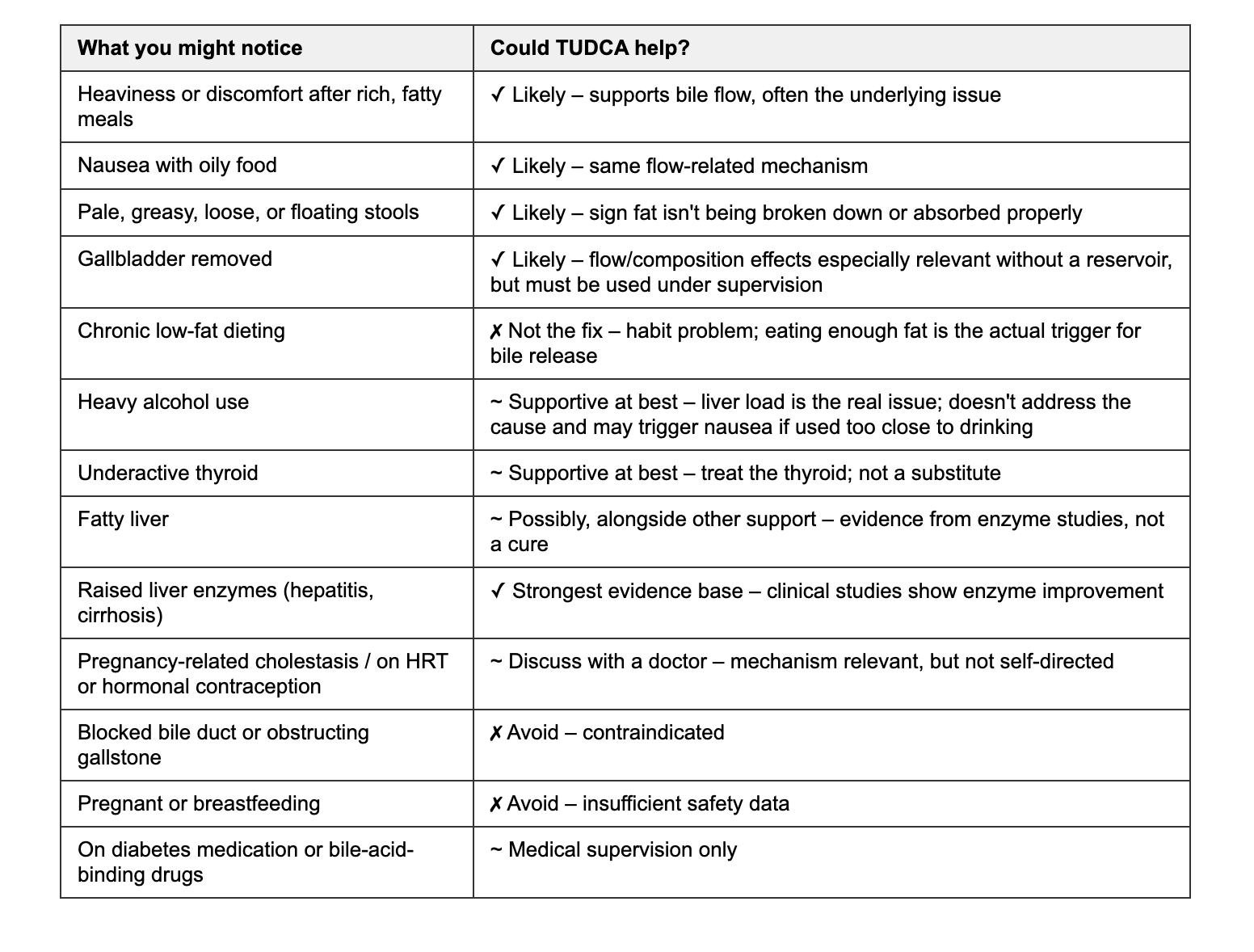
Key: ✓ good candidate · ~ conditional/needs practitioner input · ✗ not appropriate.
Where the Evidence Actually Stands
Worth stating plainly: UDCA, the compound TUDCA is derived from, is an approved medicine for primary biliary cholangitis and for dissolving cholesterol gallstones. TUDCA itself is more often used as a supplement. In clinical research, largely in people with hepatitis or cirrhosis, it has lowered raised liver enzymes and was generally well tolerated.
The metabolic evidence is thinner but genuinely interesting: a small four-week randomised trial in insulin-resistant adults found a meaningful improvement in insulin sensitivity, though the dose used was considerably higher than a typical supplement dose, we can see that the trends are leaning the in a favourable way.
Beyond that, there’s the ‘cellular protection story’, TUDCA as a “chaperone,” easing cell stress and supporting mitochondrial function - is built mostly on lab and animal studies. That doesn’t make the mechanism invalid, but any claims about energy or cellular vitality are best read as promising rather than settled.
The Detox Myth, Corrected
“Detox” is the word doing the most damage in this conversation. It implies the liver is a filter that clogs and needs periodically flushing clean, it isn’t. “The liver works every second of every day, and you cannot cleanse it over a weekend with a juice or a supplement,” says Marilia. What it actually needs is unglamorous: the raw materials to do its work - B vitamins, phospholipids, amino acids, glutathione, flavonoids, healthy bile flow so the waste it processes has somewhere to go, and not being chronically overloaded in the first place. Skip any one of those and more of what the liver processes ends up recirculating rather than leaving.
“The liver works every second of every day, and you cannot cleanse it over a weekend with a juice or a supplement”
Foundations First
Before any supplement, Marilia encourages you to eat enough fat at meals. Fat is the actual physiological trigger for the gallbladder to release bile, and chronic low-fat eating is one of the most common reasons bile stagnates in the first place.. Bitter foods (rocket, chicory, artichoke, dandelion) are traditionally used to stimulate digestive secretions. Cruciferous vegetables work differently again, supporting the liver’s processing chemistry rather than bile flow directly. Protein matters too, since bile acids are built from amino acids the body needs to have on hand.
“TUDCA sits on top of that, as a targeted tool for a specific situation, not a substitute,” Marilia says. “The foundations are the real work, and precision is layered on top once they’re in place.”
If You're Going to Try TUDCA
TUDCA is best approached as a targeted intervention rather than a default daily supplement, ideally taken because something specific points to it.. Typical doses sit around 250-500mg a day, often split and taken with food. Side effects, when they occur, are usually mild and digestive, loose stools, nausea, mild bloating and tend to settle. Don’t expect anything dramatic overnight; changes in how you tolerate fatty meals may show within a couple of weeks.
It isn’t for everyone. Anyone with a blocked bile duct or an obstructing stone should avoid it, and it isn’t recommended in pregnancy or while breastfeeding, given the lack of safety data. Anyone with significant liver disease, or taking diabetes medication or bile-acid-binding drugs, should only use it under medical supervision.
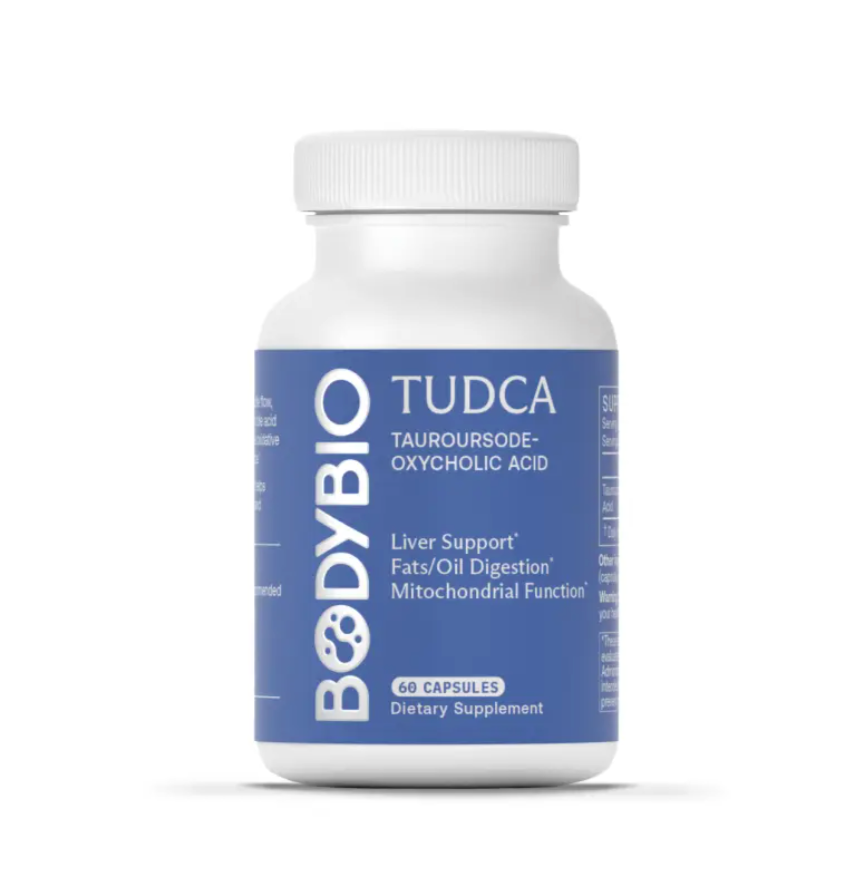
Sourcing matters here too. Older TUDCA supplements were sometimes derived from bear or bull bile, BodyBio’s TUDCA is synthetically manufactured to be biologically identical to the TUDCA the human body produces, third-party tested for purity and potency, and entirely cruelty-free. It’s the kind of detail worth checking before you buy, given how much of this category still runs on ambiguous sourcing.
The Bottom Line
Bile isn’t glamorous, which is exactly why it gets ignored until it becomes a problem. The unspectacular truth is that most people don’t need a cleanse, they need to eat enough fat and protein, get their vegetables in, keep alcohol modest, move, sleep, and stop crash-dieting their gallbladder into stagnation. For a smaller group, post-gallbladder removal, sluggish bile flow, specific liver markers, TUDCA is a genuinely useful, well-tolerated tool that many practitioners were delighted to see available back in the UK, and for a good reason too.
As always, speak to your healthcare practitioner before starting any new supplement, particularly if you are pregnant, breastfeeding, or managing an existing health condition.
Words by Marilia Chamon for The Well Edit.
The content published by The Well Edit is for informational and educational purposes only. It is not intended as, and should not be relied upon as, a substitute for professional medical, health, nutritional, legal, or financial advice. While articles may reference insights from qualified practitioners or experts, the views expressed are their own and do not necessarily reflect the views of The Well Edit. Always seek the guidance of a qualified professional before making changes to your diet, lifestyle, supplementation, or healthcare routine.
Use of any information provided is at your own discretion and risk.