Ambition. Discipline. Drive. All Hormonal?

Testosterone, Oestrogen, Your Hormones Have Opinions. You Just Think They're Yours.
There is a very specific kind of perplexity that comes from realising your inner experience is not quite as fixed as you thought it was. One week you feel magnetic, motivated, chatty, and hungry for life. The next week you are wondering why everyone is speaking too loudly, why your jeans feel offensive, and why the same text message that would normally be fine now feels like a personal attack.
We love to think of ourselves as consistent people. Calm or anxious. Confident or shy. Sexual or not sexual. Disciplined or chaotic. But the truth is that much of what we call our behavioural state or temperament is happening inside a body that is constantly changing. Your hormones are not your destiny, but they are part of the biochemical weather system you live inside every single day.
As a women’s health specialist, I think this is where the conversation online has become both fascinating and completely unhinged. We have all seen the TikToks. Someone is “oestrogen dominant”. Someone else is “progesterone deficient”. Testosterone is being blamed for male aggression. Cortisol is being blamed for everything. And while these hormones absolutely matter, they are often discussed as if they are personality types rather than chemical messengers.
So let’s strip it back. What are these hormones? What do they actually do? And how much of what we think we choose: our confidence, libido, patience, motivation, emotional sensitivity and resilience- is actually being shaped by the hormonal orchestra playing in the background.
Hormones Are Messengers, Not Moral Failings
Hormones are chemical messengers. They travel through the bloodstream and tell different tissues what to do. They influence metabolism, fertility, sleep, appetite, stress, mood, libido, skin, muscle, bone, brain function and immune activity. They are not floating around making us “crazy” or “dramatic”. They are coordinating survival.
The three sex hormones we hear about most often are testosterone, oestrogen and progesterone. All three exist in both men and women, just in different amounts and patterns. This is important because social media often frames testosterone as male and oestrogen as female, which is not biologically accurate.
One of the facts I find most interesting, and one that is not widely known, is that women generally have more circulating androgens, including testosterone, than oestrogens by concentration, even though women have much less testosterone than men [1]. Testosterone is not a male-only hormone. It is essential for women too.
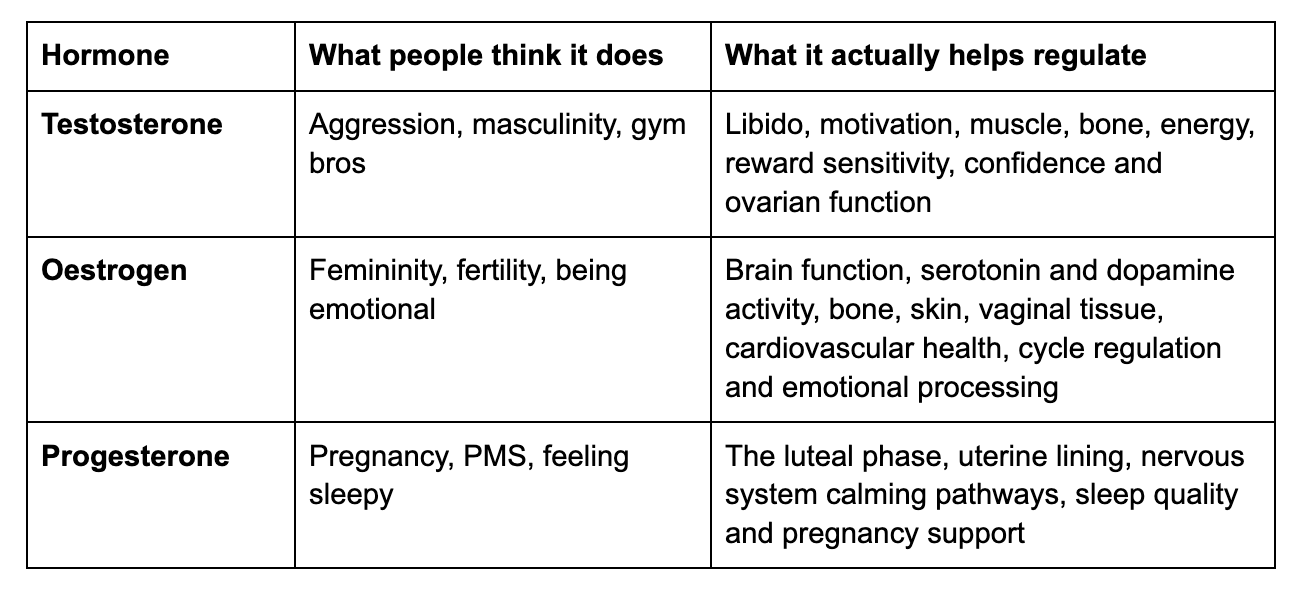
Already, you can see the problem. These hormones are not aesthetic labels. They are not good or bad. They need to be present in the right amounts, at the right time, in the right rhythm.
Testosterone Is Not Just the Aggression Hormone
Testosterone is one of the most misunderstood hormones. It is an androgen, produced mainly in the testes in men, and in smaller amounts by the ovaries and adrenal glands in women. In women, testosterone also acts as a precursor to oestrogen, because it can be converted into oestradiol by an enzyme called aromatase [1].
When people talk about testosterone, they often jump straight to aggression. It is the classic “boys will be boys” hormone. But the science is far more interesting than that.
A large meta-analysis examining testosterone and aggression in humans found that the relationship is weak, especially when you look at baseline testosterone levels alone [2]. In other words, high testosterone does not automatically equal an aggressive person. Context matters. Personality traits (like those in the Big Five model) are generally stable. What we are discussing here are more fluid behavioural states or temperamental shifts.
Some researchers now argue that testosterone is better understood through the lens of status, motivation and reward. In one double-blind study, testosterone increased both punishment of unfair behaviour and rewarding of generous behaviour, suggesting it may amplify behaviours that help someone gain or protect status rather than simply making them more antisocial [3].
This is such a better way to understand it. Testosterone can support drive, libido, competitiveness, assertiveness, energy and the willingness to take action. Too little, and someone may feel flat, tired, low in desire or unmotivated. Too much, or poor sensitivity to it, and you might see acne, hair changes, irregular cycles, mood changes or symptoms associated with conditions like PCOS.
But testosterone is not a villain. It is not a behavioural defect. It is part of the reason you want things, pursue things and feel alive enough to go after them.
Oestrogen Is Not Just About Fertility
If testosterone is often reduced to aggression, oestrogen is often reduced to fertility. But oestrogen is not just the hormone that makes you ovulate and have a period. It is deeply involved in the brain.
Oestrogen receptors are found in areas involved in emotion, memory and cognition, including the hippocampus, amygdala and prefrontal cortex [4]. Oestrogen also interacts with neurotransmitter systems like serotonin, dopamine and noradrenaline, which is one reason changes in oestrogen can affect mood, motivation and emotional processing [4].
This is why some women feel brighter, more social, more attractive and more mentally switched on in the first half of the cycle, especially around ovulation when oestrogen peaks. It is also why libido can increase around ovulation. From a biological perspective, that is the fertile window. Our body is very intelligent, it knows exactly what it is doing.
This does not mean every woman feels amazing at ovulation. Some women get ovulation pain, anxiety, migraines, bloating or mood changes. But for many, there is a noticeable shift. You may feel more confident, more outward-facing, more interested in being seen.
It is also why perimenopause can feel so destabilising. Oestrogen does not simply glide down in a neat straight line. During perimenopause, it can fluctuate dramatically before declining more consistently after menopause [5]. Research has linked the menopausal transition with increased vulnerability to depressive symptoms and some cognitive changes, particularly around memory and verbal fluency [5]. So when women say they feel like they are “not themselves” in perimenopause: they are not losing their minds, their hormonal environment is changing.
Progesterone: The Hormone Everyone Blames But Few Understand
Progesterone rises after ovulation, during the luteal phase. Its main job is to prepare the uterine lining for a potential pregnancy. If pregnancy does not happen, progesterone falls and the period begins.
But progesterone is not just a reproductive hormone. It also interacts with the nervous system. One of its metabolites, allopregnanolone, acts on GABA-A receptors, which are involved in calming the brain [6]. This is one reason progesterone is often associated with feeling more relaxed, sleepy or inward.
In an ideal world, the luteal phase is a time when you naturally want to slow down slightly. You may need more food, more sleep, more magnesium, fewer late nights and less overcommitting. But again, this is where nuance matters. Some women feel calmer with progesterone. Others feel anxious, low, irritable or intensely premenstrual. Sensitivity to hormonal change can matter as much as the absolute hormone level itself.
This is also where we need to be clear about language. Natural progesterone is not the same as synthetic progestins or progestogens used in many hormonal contraceptives. They can act differently in the body and brain. Many reviews have found that hormonal contraception can affect mood in women, with the relationship often depending on the type and amount of progestogen, although certain women tolerate hormonal contraception well [4].
The Menstrual Cycle Is Not a Flaw, It Is a Rhythm
The menstrual cycle is not just a monthly inconvenience. It is a changing hormonal landscape. This is why trying to live the exact same way every single day of the month can feel like fighting your own biology.
Research suggests that while core personality traits (like those in the Big Five model) remain stable, personality states or temperamental expressions can fluctuate across the menstrual cycle [7]. For instance, some studies indicate a robust premenstrual increase in neuroticism and negative affect, alongside decreases in extraversion and positive affect [7]. Conversely, during the ovulatory phase, some women report feeling more extraverted and socially engaged [7]. These are not changes to your fundamental personality, but rather shifts in how those traits are expressed or experienced.
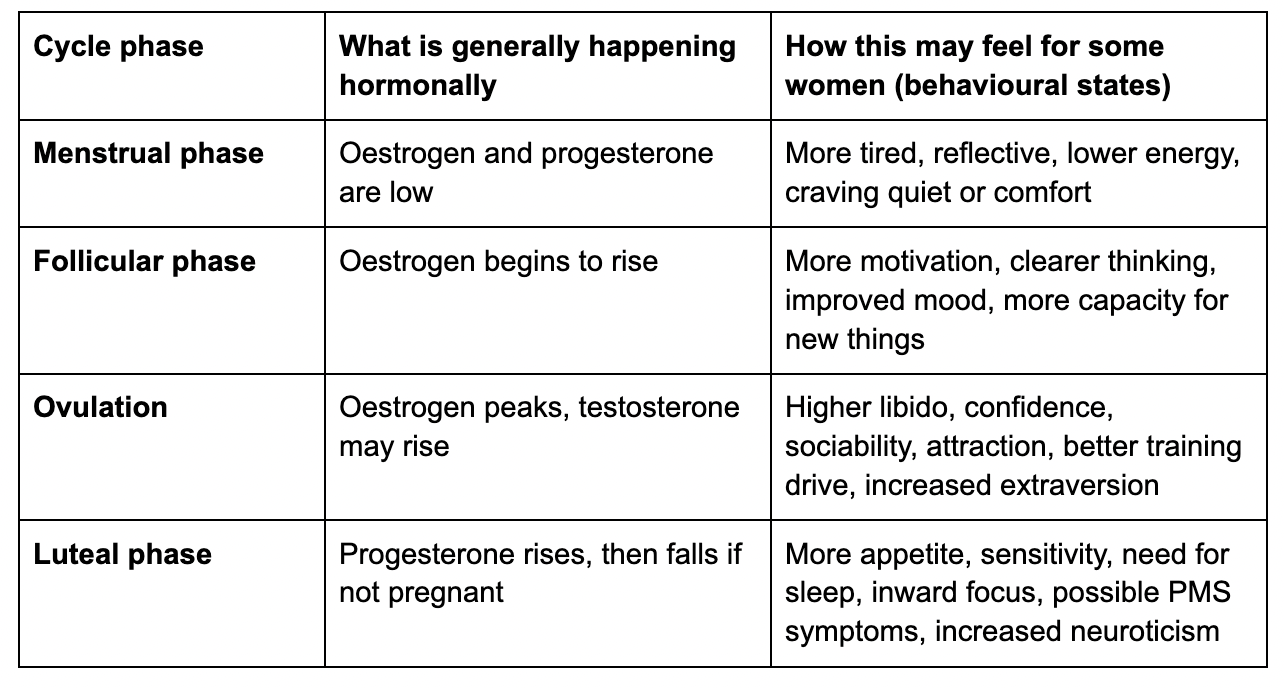
This table is not a rulebook. It is a map. Not every woman feels these changes dramatically, and some women do not have a natural cycle because of hormonal contraception, pregnancy, breastfeeding, hypothalamic amenorrhoea, PCOS, perimenopause or other factors. But for many women, understanding these shifts is the first time they stop gaslighting themselves.
You are not failing because your motivation changes across the month. You are not weak because your tolerance for stress is different before your period. You are not “too much” because your libido rises around ovulation. You are a cyclical person living in a culture that often expects women to behave like men.
When the Orchestra Goes Off-Key
The body is not a collection of separate wellness hacks. It is an orchestra. Testosterone, oestrogen and progesterone matter, but so do thyroid hormones, cortisol, insulin, leptin, melatonin and the signals coming from your gut, brain, immune system and environment.
This is why hormone health is rarely about one hormone being “bad”. It is about communication. The hypothalamic-pituitary-adrenal axis, often called the HPA axis, helps regulate the stress response through the brain, pituitary gland and adrenal glands [8]. The hypothalamic-pituitary-ovarian axis coordinates the reproductive cycle. The thyroid helps regulate metabolism, energy, temperature and mood. These systems talk to each other constantly.
Sleep is one of the biggest foundations. In a small but important JAMA study, one week of restricting sleep to five hours per night lowered daytime testosterone levels by 10 to 15 per cent in healthy young men and reduced their sense of vigour [9]. That is not a small thing. If sleep can shift testosterone that quickly, imagine what months or years of poor sleep, stress and late-night scrolling can do to how someone feels in their body.
Food matters too. Especially for women. Under-eating and over-exercising can be interpreted by the body as stress. In athletes, low energy availability can disrupt reproductive hormone production and contribute to menstrual irregularities, impaired bone health, psychological symptoms and reduced performance [10]. You cannot Pilates and coffee your way into balanced hormones if your body does not feel safe enough to ovulate.
Stress matters. Not because cortisol is evil, but because cortisol is a survival hormone. You need it to wake up, respond, move and adapt. But when stress is constant, whether that is emotional stress, blood sugar stress, poor sleep, overtraining, under-eating or chronic inflammation, the body will prioritise survival over reproduction and libido.
This is why the “hormone balancing” conversation has to become more sophisticated. Sometimes the answer is not another supplement. Sometimes it is breakfast. Sometimes it is lifting weights instead of doing another punishing HIIT class. Sometimes it is getting off your phone earlier. Sometimes it is asking whether your contraception still suits you. Sometimes it is testing thyroid, iron, vitamin D, prolactin, androgens, fasting insulin or cortisol patterns with a practitioner who actually listens.
So, What Can We Actually Do?
The most useful hormone advice is usually not sexy. It is not a £200 Instagram protocol. It is the boring but powerful work of making your body feel safe, nourished and rhythmic.
Start with sleep. Your hormones are built on circadian rhythm, so protect your evenings where you can. Get morning light. Eat enough food, especially protein and healthy fats. Do not drink coffee on an empty stomach if it makes you anxious or shaky. Strength train because muscle is metabolically protective and confidence-building. Move in ways you can actually repeat weekly, not in ways that make you feel punished.
Track your cycle if you have one. Not obsessively, but curiously. Notice when your libido rises, when your anxiety spikes, when you need more sleep, when you feel strongest in the gym, when you want to be social and when you need to be left alone. This is data. Not to control yourself, but to understand yourself.
If your mood changes are severe, if your periods are missing, if your PMS feels unmanageable, if your libido has disappeared, if your hair is shedding, if you feel persistently exhausted, or if you feel like a totally different person after starting or stopping contraception, please do not let anyone tell you it is “just being a woman”. It may be common, but that does not mean it is normal. This might be a sign you need to listen to your body and start asking deeper questions about what your hormonal orchestra is trying to tell you.
Hormones Are Context, Not Destiny
The point of this article is not that women are ruled by hormones and men are ruled by testosterone. That would be boring, reductive and scientifically lazy. The point is that hormones shape the context in which we experience ourselves.
Maybe confidence is not just a mindset. Maybe libido is not just attraction. Maybe irritability is not just a character flaw. Maybe anxiety, drive, softness, competitiveness, sociability and resilience are all influenced by what your body is trying to do hormonally at that moment.
That does not remove responsibility. It gives us information.
You are still you at every point in your cycle, at every life stage, on contraception, off contraception, in stress, in rest, in perimenopause, in healing. But the version of you that emerges is influenced by whether your body feels nourished, rested, safe, supported and hormonally in tune. And that is why it is so important to know ourselves, take care of ourselves and meet ourselves exactly where we are, whether that is on the dance floor during peak LH and FSH, or wrapped in bed with a high BBT.
Words by Eva Fleischman for The Well Edit.
References
Hammes, S. R. & Levin, E. R. (2019). Impact of estrogens in males and androgens in females. Journal of Clinical Investigation. Available at: https://pubmed.ncbi.nlm.nih.gov/31042159/
Geniole, S. N. et al. (2020). Is testosterone linked to human aggression? A meta-analytic examination of the relationship between baseline, dynamic, and manipulated testosterone on human aggression. Hormones and Behavior. Available at: https://pubmed.ncbi.nlm.nih.gov/31785281/
Dreher, J. C. et al. (2016). Testosterone causes both prosocial and antisocial status-enhancing behaviors in human males. Proceedings of the National Academy of Sciences. Available at: https://www.pnas.org/doi/10.1073/pnas.1608085113
Mu, E. & Kulkarni, J. (2022). Hormonal contraception and mood disorders. Australian Prescriber. Available at: https://pmc.ncbi.nlm.nih.gov/articles/PMC9218393/
Weber, M. T., Maki, P. M. & McDermott, M. P. (2013). Cognition and mood in perimenopause: A systematic review and meta-analysis. Journal of Steroid Biochemistry and Molecular Biology. Available at: https://pmc.ncbi.nlm.nih.gov/articles/PMC3830624/
Sundström Poromaa, I. & Gingnell, M. (2014). Menstrual cycle influence on cognitive function and emotion processing. Frontiers in Neuroscience. Available at: https://pmc.ncbi.nlm.nih.gov/articles/PMC4241821/
Stern, J. et al. (2025). Patterns in affect and personality states across the menstrual cycle. Psychological Science. Available at: https://pubmed.ncbi.nlm.nih.gov/39804343/
Sheng, J. A. et al. (2021). The Hypothalamic-Pituitary-Adrenal Axis: Development, Programming Actions of Hormones, and Maternal-Fetal Interactions. Frontiers in Behavioral Neuroscience. Available at: https://pmc.ncbi.nlm.nih.gov/articles/PMC7838595/
Leproult, R. & Van Cauter, E. (2011). Effect of 1 Week of Sleep Restriction on Testosterone Levels in Young Healthy Men. JAMA. Available at: https://pmc.ncbi.nlm.nih.gov/articles/PMC4445839/
Cabre, H. E. et al. (2022). Relative Energy Deficiency in Sport (RED-S): Scientific, Clinical, and Practical Implications for the Female Athlete. Deutsche Zeitschrift für Sportmedizin. Available at: https://pmc.ncbi.nlm.nih.gov/articles/PMC9724109/
Lahimer, M. et al. (2023). Endocrine disrupting chemicals and male fertility: from physiological to molecular effects. Frontiers in Public Health. Available at: https://pmc.ncbi.nlm.nih.gov/articles/PMC10598475/
The content published by The Well Edit is for informational and educational purposes only. It is not intended as, and should not be relied upon as, a substitute for professional medical, health, nutritional, legal, or financial advice. While articles may reference insights from qualified practitioners or experts, the views expressed are their own and do not necessarily reflect the views of The Well Edit. Always seek the guidance of a qualified professional before making changes to your diet, lifestyle, supplementation, or healthcare routine.
Use of any information provided is at your own discretion and risk.