Hypochlorous Acid vs Niacinamide: What Skincare Experts Really Recommend
Scroll through any skincare aisle or TikTok feed right now and you'll see two ingredients competing for space in your routine: hypochlorous acid and niacinamide. Both are marketed as gentle, science-backed essentials, but they work in completely different ways, solve different problems and, according to the experts, aren't really interchangeable at all.
To cut through the marketing noise, we asked a skin specialist and a dermatologist to explain, in clinical terms, how hypochlorous acid and niacinamide actually behave on the skin, who should be using each one, and whether they belong in the same routine at all.
What Is Hypochlorous Acid (HOCl)?
Hypochlorous acid, often shortened to HOCl, is a molecule your immune system already produces naturally to fight off microbes. In skincare form, it's used primarily as an antimicrobial and anti-inflammatory agent rather than an active that changes the skin's structure over time.
"Hypochlorous acid works on the surface and it works fast," explains Eleanor Hartley, a skin specialist. "When using it pre and post treatment, we expect an immediate antimicrobial action before injections or microneedling. Post treatment, patients feel less angry redness and less itchiness during healing."
Dr Jordan Faulkner, a cosmetic doctor, agrees that its role is narrower than niacinamide's. "Hypochlorous acid is primarily antimicrobial, so its main role is helping to reduce microbial load on the skin," he says.
The name causes more confusion than almost anything else about this ingredient. Despite containing the word "acid," HOCl is not an exfoliant. "The most common misconception is probably the word acid," Hartley says. "Patients hear acid and assume it's exfoliating their skin in the same way as glycolic, lactic or salicylic acid. It isn't. HOCl isn't an exfoliating acid, it's an antimicrobial and inflammatory-modulating molecule that actually forms part of our innate immune defence." Its faint chlorine-like smell adds to the misunderstanding, often leading people to assume it's harsher than it actually is, when in reality it's highly anti-inflammatory.
d. "Studies show that the B3 derivative upregulates ceramide and cholesterol synthesis and reduces transepidermal water loss (TEWL), it supports the skin to make its own barrier lipids," Hartley explains. "But this is a long process taking up to 12 weeks, so it supports the skin barrier on a longer-term basis."
Dr Faulkner describes niacinamide's role as far broader than HOCl's. "It supports the skin barrier, ceramide production, hydration, inflammation and pigmentation," he says. "I wouldn't see them as direct alternatives because they're doing different jobs, but for healthy skin and consistent everyday use, I think niacinamide has the broader role."
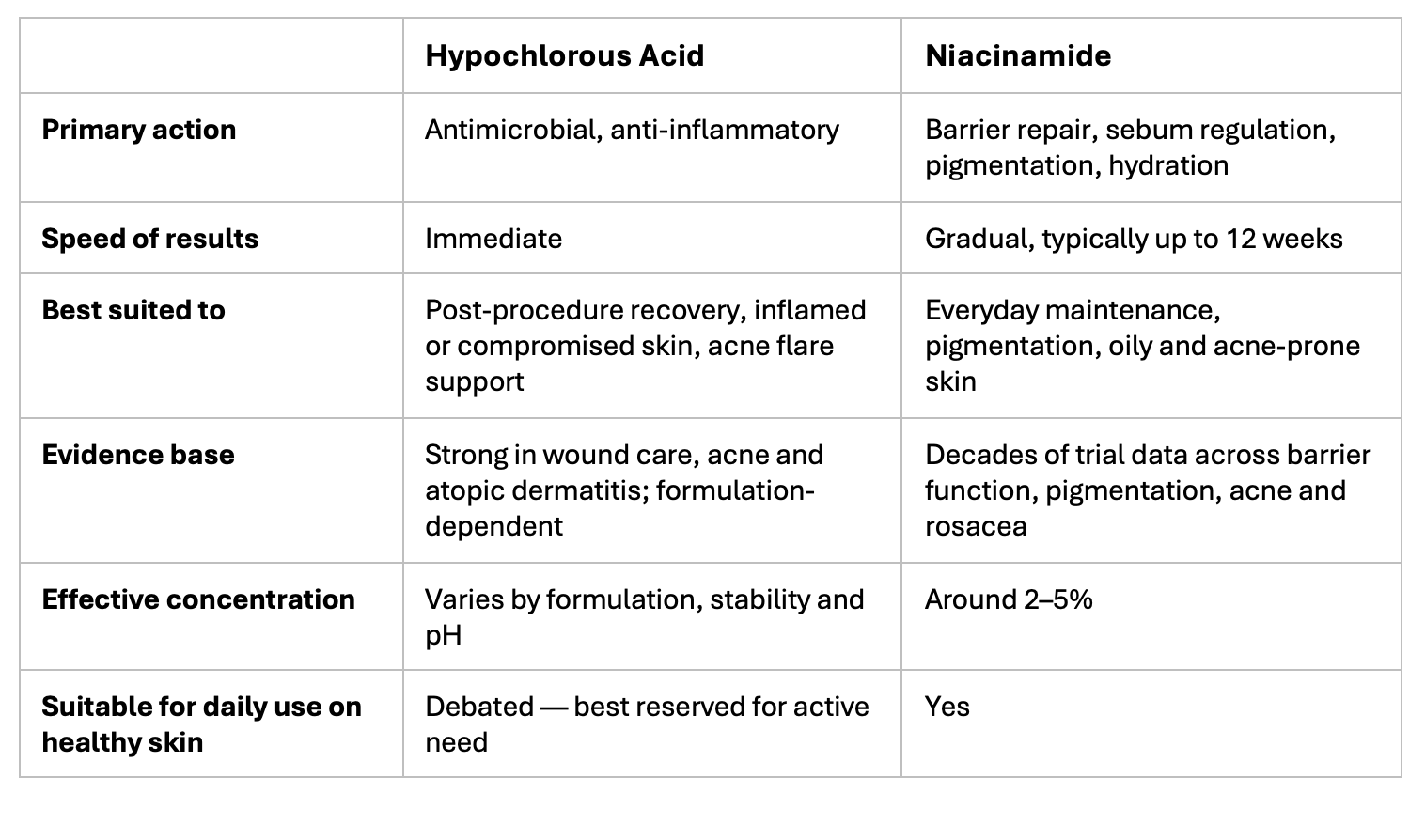
Hypochlorous Acid vs Niacinamide: The Key Differences
When to Reach for Hypochlorous Acid
Both experts agree that hypochlorous acid earns its place as a clinical tool rather than a daily essential for healthy skin. Hartley reaches for it "when the problem is microbial, inflammatory or post-procedure recovery" particularly straight after energy-based or injectable treatments, where it offers antimicrobial cover "without the cytotoxicity of an alcohol wipe, which can really trigger more sensitive or inflamed skin." She also finds it useful for calming atopic skin and eczema flares.
Dr Faulkner sees a place for it in acne-prone skin, too, largely because of its convenience. "If someone wants something they can conveniently spritz onto the skin throughout the day, hypochlorous acid has that convenience element," he says. "Its antimicrobial action can be useful, particularly for acne-prone skin, and it can work synergistically alongside other medically prescribed preparations."
“I’ve worked with clients with topical skin conditions frequently and have suggested Clinisoothe and Clinisolve in times of irrittation, flare ups and contact with irritants.”
When to Reach for Niacinamide
For pigmentation, oily skin and long-term barrier support, both experts point to niacinamide first. Hartley uses it as her go-to "for pigmentation, where it interrupts melanosome transfer, and for oily and acne-prone skin, where it reduces sebaceous activity."
Dr Faulkner takes the same view for everyday routines: "As part of a regular skincare routine, I would generally lean towards niacinamide because of its broader benefits around barrier function, inflammation and hydration."
It's worth noting that both experts are clear that neither ingredient replaces proper medical treatment for diagnosed conditions like acne, rosacea or eczema. As Dr Faulkner puts it, they "should be considered adjuncts rather than complete treatments" and shouldn't replace appropriate medical care where that's needed.
“We’re currently using the newly formulated Myokine Refresh, a post-exercise skincare product, with 4% niacinamide. Rather than a high percentage inclusion simply because it sounds more powerful, the product has been designed as a ‘post exercise’ skin refresh along side other ingredients so you can sprtiz your face post sweaty spin class and get home without bacteria having an impact.”
-
Neither replaces medical acne treatment, but hypochlorous acid's antimicrobial action can help manage bacterial load and redness during flares, while niacinamide works over time to reduce sebum production and calm underlying inflammation. Many people use both, in the right order, alongside prescribed treatment where needed.ion text goes here
-
You can, but both experts suggest it's best reserved for times of genuine need, post-procedure recovery, active breakouts, or flare-ups rather than as a permanent daily step on otherwise healthy skin, due to open questions about its long-term effect on the skin microbiome.
-
The clinical evidence consistently points to 2–5% as the sweet spot, offering proven benefits with minimal risk of the flushing or irritation that can occur at higher concentrations.
-
Yes, it's often used specifically for this purpose, as it's anti-inflammatory and less likely to trigger irritation than alcohol-based antimicrobials. It's a common choice for calming atopic and eczema flares
Can You Use Hypochlorous Acid and Niacinamide Together?
Yes - but with a specific order of operations. Because hypochlorous acid is a reactive, oxidising molecule, it needs to be fully dry on the skin before anything else is applied, or it risks deactivating or reacting unpredictably with other ingredients.
"If you are using HOCl as part of a routine, consider it should be used as an anti-inflammatory or antimicrobial, spritz and let it dry before then applying the rest of your skincare," Hartley says. Dr Faulkner gives the same caution around layering HOCl with antioxidants like vitamin C, recommending you "allow the HOCl to dry fully first."
There's also a bigger question both experts raise: whether hypochlorous acid should be used daily at all. "We do have to question the overuse of HOCl as part of a daily routine," says Hartley. "Dermatologists have questioned whether it may disrupt the microbiome and reduce the good microbes that actually support skin health. That's why we typically recommend it for skin that is actively inflamed or jeopardised, or post-procedure."
Dr Faulkner echoes the concern from a research standpoint: "The biggest gap with HOCl is long-term, frequent use on otherwise healthy skin, particularly what repeated antimicrobial use could mean for the skin microbiome." He points to a marketing claim he sees often, that because hypochlorous acid occurs naturally in the body, everyone should be using it daily as part of general skin health. "We simply don't yet have the long-term data to understand what repeatedly applying an antimicrobial in this way could mean for the skin microbiome," he says. "That doesn't mean HOCl isn't useful. It absolutely has clinically relevant applications. But there's an important distinction between using an antimicrobial because there is a reason to use one, and suggesting that everyone should routinely apply one to healthy skin as a preventative or general wellness measure."
The "More Is Better" Myth With Niacinamide
Niacinamide has its own common misconception: that a higher percentage automatically means better results. "High doses of B3 can trigger histamine release in the skin, so some people will experience flushing and redness at higher concentrations," Hartley explains. "The clinical data shows effective results at between 2–5%, and here is where the skin can tolerate it consistently."
Dr Faulkner sees the same pattern from a formulation standpoint. "More isn't necessarily better," he says. "Higher concentrations can cause irritation or flushing in some people, and many of its established benefits have been demonstrated at around 2 to 5%." It's why he formulated Myokine Refresh, a post-exercise skincare product, with 4% niacinamide - "an evidence-led concentration within a wider formulation, rather than adding a high percentage simply because it sounds more powerful."
So, Which One Should You Choose?
If you can only add one ingredient to your routine, both experts land on the same answer: niacinamide.
"If I could only choose one, niacinamide, for sure," says Hartley. "It has thirty years of controlled human trials behind it across four separate endpoints: barrier lipid synthesis, sebum regulation, pigmentation and photoageing. It's stable, very well tolerated by almost every skin type, and it plays well with nearly everything else in the bathroom cabinet."
That doesn't make hypochlorous acid redundant, far from it. "Hypochlorous acid is a genuinely useful clinical tool that I couldn't live without in the clinic," Hartley adds, "but it's not an absolute necessity for every day use in perfectly healthy, uncompromised skin. Its strong evidence sits in wound healing, inflammation and eczema-related inflammation."
Words by Eleanor Hartley for The Well Edit.
The content published by The Well Edit is for informational and educational purposes only. It is not intended as, and should not be relied upon as, a substitute for professional medical, health, nutritional, legal, or financial advice. While articles may reference insights from qualified practitioners or experts, the views expressed are their own and do not necessarily reflect the views of The Well Edit. Always seek the guidance of a qualified professional before making changes to your diet, lifestyle, supplementation, or healthcare routine.
Use of any information provided is at your own discretion and risk.