
The Most Ironic Wellness Purchase I’ve Made as a Professional Plate-Spinner
This is Eleanor’s review of Brick
Last year, I went fully off-grid with Unplugged. No signal. No Slack. No background hum of being available.
It was supposed to be restorative. It ended up being pretty revealing. Within the first 24 hours, I realised I wasn’t just “busy” or “in demand”. I was compulsive. My nervous system had adapted to constant stimulus. My thumb had its own mind to always deviate to unlock, check Slack, Instagram, email, refresh & repeat. The behaviour felt automatic, almost pre-verbal and totally normalised.
When the signal disappeared, something else surfaced: agitation. Then relief. Then a strange freedone that felt like returning to an earlier version of myself. Read my Uplugged Review
We talk about phone addiction casually, but the neurobiology is not accidental. Smartphones operate on what behavioural psychologists call a variable reward schedule. You never quite know what will be waiting when you open the app. A message. A sale. A compliment. That unpredictability is the hook. Each possibility releases dopamine, the neurotransmitter of anticipation and pursuit. It is not the content that wires us in. It is the possibility of reward.
And when you work across three time zones, believe me when I say that slot machine never closes.
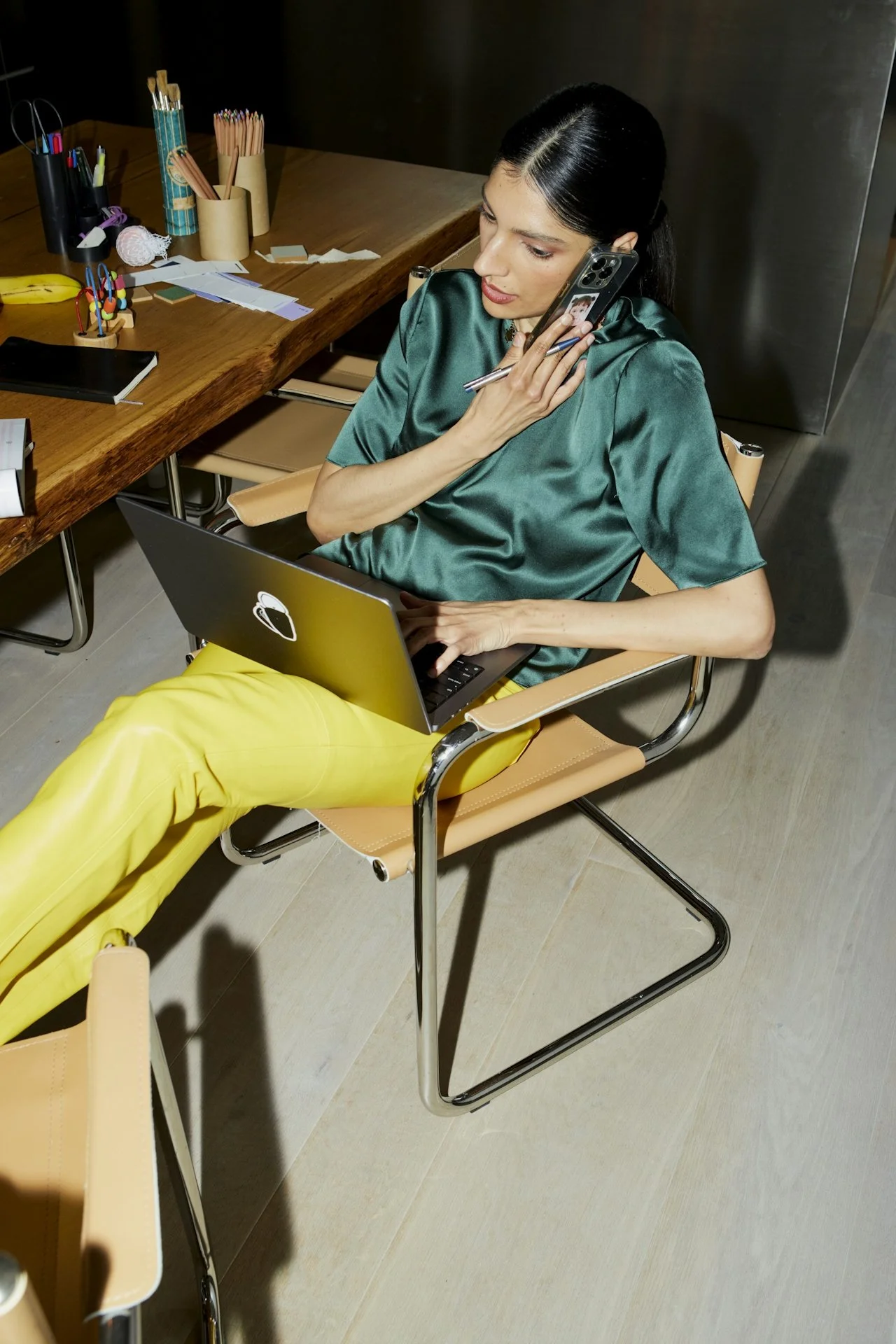
I operate between London, Australia and the US. Just as I am trying to soften into evening, the Australian team wakes up. Slack begins to ping. Emails stack. A “quick check” becomes a cortisol drip. I would tell myself I was being efficient. In truth, I was keeping my nervous system on permanent standby.
Even after returning from Unplugged, I noticed old patterns creeping back. I would plan intentional green time before screen time. I would step outside, committed to a device-free walk. And somehow, halfway down the road, I would be scrolling or “just checking”.
Then my algorithm, which knows me disturbingly well, began serving me ads for the Brick Device. Repeatedly. Relentlessly. I remember laughing at the irony. Of course my phone knew I was trying to use it less.
The ads worked.
There is something deeply modern about being marketed a solution to the problem the marketing ecosystem helped create. And yet, I bought it.
The Brick Device is tiny, no bigger than the palm of my hand and resembles the tiny contactless payment device I see frequently at the Farmers Market. You simply, tap your phone against it and the selected apps become blocked. To access them again, you must physically return and tap the Brick again. Of course, you are able to ‘emergency unbrick your phone’ but you only get five of these per month so you will avoid using them unless it REALLY is an emergency. Or, if you’re like me and need to show the email confirmation for your Psycle RIDE class to realise, you didn’t actually book on.
Compulsive behaviour thrives on immediacy. The shorter the gap between urge and action, the stronger the loop. By introducing physical effort, you shift the behaviour from automatic to intentional. Behavioural research consistently shows that even small increases in friction significantly reduce impulsive engagement. If I have to stand up, walk to my hallway, and consciously unbrick my phone to open Slack, I often decide not to.
The Brick now lives next to the key bowl in my hallway. It is part of my ritual. Keys down. Phone tap. Boundary restored.
Before I go for a walk, I brick my phone. I still take it with me. It is my wallet, my emergency contact, my train ticket. But Slack and Instagram disappear. If I want them back, I have to go home. That single design choice has transformed my walks. They are quieter. Slower. My mind wanders without being hijacked mid-thought.
I have created multiple modes:
• No Work
• No Social
• Total Dopamine Detox, reserved for Sundays
The Sunday setting is brutal in the best way. The first time I did it, I instinctively reached for Slack while on the sofa with a friend. Nothing opened. I felt the irritation - fascinating. Then I relaxed. The urge passed and I reminded myself I’ll check with intention, and therefore in a more productive manner, later.
Without the constant micro spikes of dopamine, your baseline recalibrates. High-stimulation inputs lose their dominance. Lower-stimulation pleasures regain pleasure. A coffee with a friend feels present. A conversation runs longer. I notice the way the sun hits my face instead of the horrid blue glow in my palm.
I have deliberately carved out a few tech-free hours a week. Not as a productivity hack. As a nervous system hygiene practice. My friends have noticed I am slower to reply. The ones who saw the previous version of me, always available, slightly wired, understand. They are proud. So am I.
I now tell everyone to do Unplugged alone at least once. Go without signal. Watch what surfaces. It is confronting. It is clarifying. And then, crucially, do not let it be a one-off retreat fantasy. Bring a fragment of that calm home. For me, the Brick is that fragment. (Brick, Unplugged - chat, there’s an idea there).
Unplugged is the deep reset. The Brick is the daily maintenance. It is the bridge between retreat and reality. I recommend both with the same conviction. Take yourself off-grid. Then design your environment so you do not slide straight back into the same patterns.
There is an absurdity in having to purchase a device to stop using a device. I am aware of it every time I tap my phone against it. But we live inside systems designed for capture. Our attention is currency. It is naïve to assume willpower alone will compete with billion-pound behavioural design.
So I redesigned my own micro-environment, and honestly it feels quite chic.
The Brick Device is not anti-technology, and neither am I. I love technology, I run a business across continents because of it. It isn’t about renouncing technology, but reclaiming authorship over your attention.
It has reminded me that boundaries are easier to keep when they are built into the architecture of your day. That dopamine is powerful, but it is not invincible.
My phone no longer feels like an extension of my hand. It feels like a tool again and truthfully, it’s been better for my business and all of my work because my time in it is intentional rather than a fleeting ‘quick check’.
And that, in 2026, feels quietly radical.
The content published by The Well Edit is for informational and educational purposes only. It is not intended as, and should not be relied upon as, a substitute for professional medical, health, nutritional, legal, or financial advice. While articles may reference insights from qualified practitioners or experts, the views expressed are their own and do not necessarily reflect the views of The Well Edit. Always seek the guidance of a qualified professional before making changes to your diet, lifestyle, supplementation, or healthcare routine.
Use of any information provided is at your own discretion and risk.