Fascia Is the New Facelift: Why Your Face Begins at Your Feet
Somewhere between the retinol and the radiofrequency, we've stopped asking the one question that actually matters: why is the face changing in the first place? Not what cream, what device, what filler, but what, deeper down, is causing a true epidemic in the drooping face shape. Whilst we've already delved into the impact of fillers on our lymphatic system, and understood a correlation between rapid weight loss and reduced facial fullness, we're still working out the real solutions to focus on when what we actually want is a face that feels full and lifted.
The answer, according to Olga Newman, founder of the Face Up Method, has very little to do with skin. It has to do with fascia, the connective web running beneath everything, and a great deal to do with the rest of your body. Your neck. Your breathing. The way you've walked, sat and held yourself for the last twenty years. Even, in some cases, a scar from a Caesarean section you had a decade ago.
"Your face doesn't begin at your chin," Newman says. "It begins at your feet."
What fascia actually is (and why "connective tissue" undersells it)
Fascia is usually filed away as the anatomical equivalent of packing tape, the stuff that holds muscles and organs in place. Newman prefers a different description: the body's communication network. It surrounds and links every muscle, bone, vessel and organ, turning what looks like hundreds of separate parts into one continuous system.
Its job, she explains, is contradictory by design. Fascia separates structures so they can move independently, and connects them so they can move together, distributing tension, force and movement across the entire body. Nothing operates in isolation. Which means the loss of definition you're noticing along your jawline may not be a jawline problem at all. It might be a posture problem, a breathing problem, or the downstream effect of an old injury nowhere near your face.
"Sometimes the area influencing the face is nowhere near the face itself," Newman notes. A Caesarean scar, a change in gait (yes your feet), restricted movement through the ribcage, the body is constantly redistributing tension to adapt, and the face, being the most visible endpoint, is often where you see the bill land.
For Newman, this isn't theoretical. It's how the entire method began.
Read - Why Your Botox Isn’t Lasting
Read - The Structural Shift: What Fillers Mean for Lymphatic Movement
The face was never the destination
Like a lot of women, Newman started working on her own face for the most ordinary of reasons: she wanted to look like herself again. After the birth of her first child, she didn't recognise her own reflection. At the time, she assumed the problem was cosmetic. Looking back, she's since realised it was never really about appearance at all, it was about wanting her confidence back, and wanting to feel like herself.
Pregnancy and birth reorganise the body in ways most of us never clock consciously. Posture shifts. Breathing shifts. Movement shifts. The body adapts around all of it, and Newman simply noticed that her face looked and felt different, without understanding why.
What she hadn't expected was that working on her face didn't stay contained to her face. "My neck felt freer, my posture gradually changed, I breathed differently and, perhaps most importantly, I started feeling more like myself again," she says. That was the moment the whole premise of Face Up crystallised for her: the face isn't the destination. It's the doorway.
Every client since has added a layer to that theory. "I found the body to be an extremely fascinating and intelligent system," she says. "Every conversation, every assessment and every transformation revealed another layer of connection that I hadn't seen before." The method, as she describes it, wasn't built around one clever technique but evolved out of thousands of small observations that kept pointing at the same conclusion: understand the body as one system, and the face starts to make a great deal more sense. The precise way that The Well Edit was founded.
The cake-and-icing problem
Newman's explanation for why surface treatments plateau is disarmingly simple. Picture a cake with perfect icing. The icing is your skin; the cake is everything underneath, muscle, fascia, structure. Smooth the icing all day, but if the layers beneath are shifting or losing integrity, the cracks keep resurfacing, because the actual change is happening somewhere the icing can't reach.
"No cream, injectable, tape or treatment can replace the role of a well-functioning body," she says. Muscles respond daily to stress, emotion, breathing and posture, and those repeated contractions gradually author the expression that ends up on the surface. Chase the wrinkle, and you're editing a symptom. Address the system underneath, and the face tends to follow.
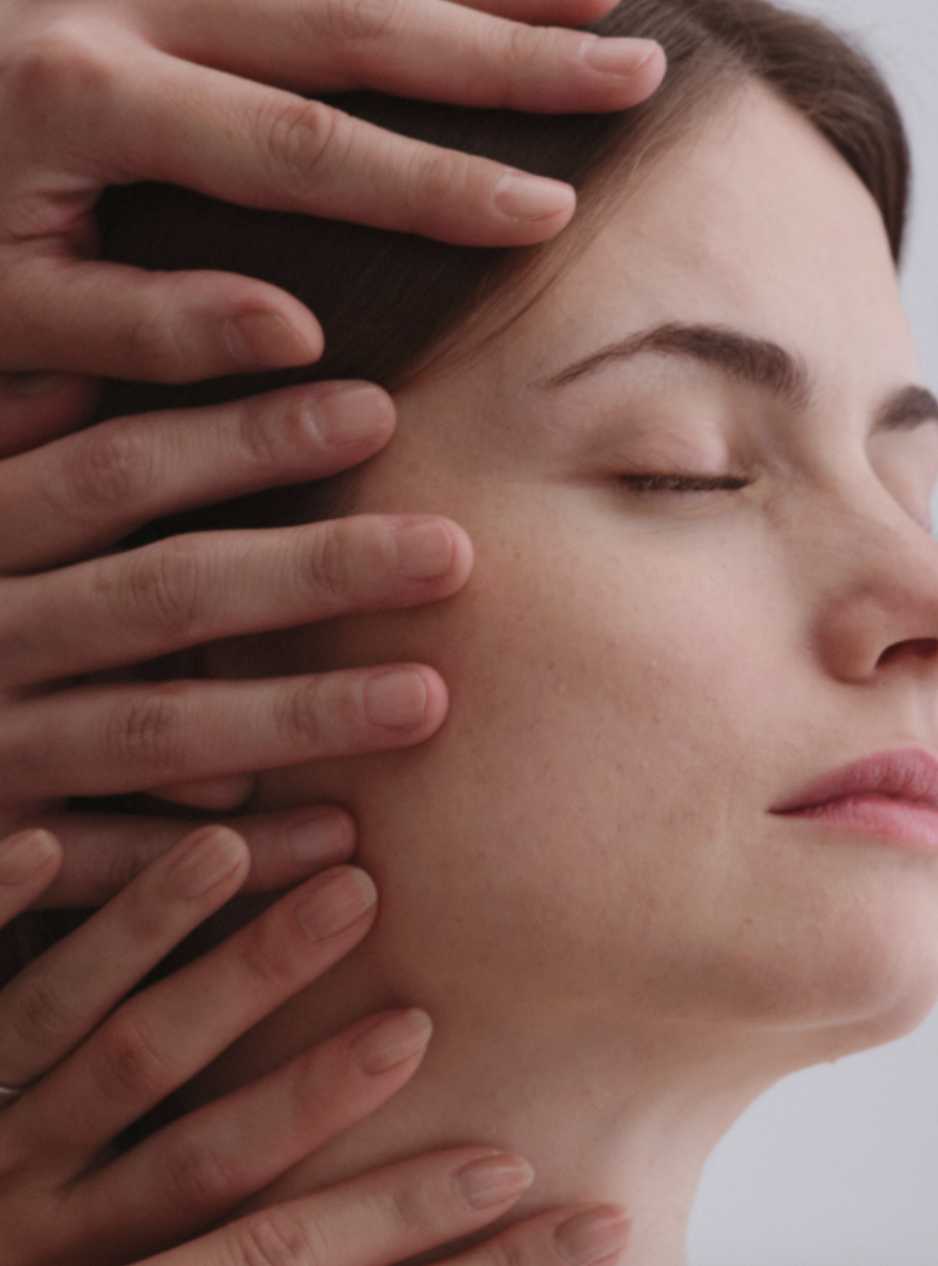
It's why Face Up sessions rarely stay on the face. Newman works the neck, scalp, chest, shoulders and even the feet, areas that govern posture, circulation and lymphatic drainage far more than the small muscles of the face ever could. "There are many sessions where we spend surprisingly little time working directly on the face," she says. "Sometimes it's only the final few minutes, because the most important work has already happened elsewhere." Her favourite moment, she says, is a client remarking that their forehead looks smoother, despite never having been touched.
The jaw is not the problem. The jaw is the evidence.
If there's one pattern Newman sees more than any other, it's jaw tension, clenching, grinding, the low hum of TMJ complaints that have become almost a generational default. She doesn't read this as a jaw issue. She reads it as a body doing what bodies do: finding somewhere to put the load.
"The jaw is rarely carrying only jaw tension," she says. "It's reflecting what's happening throughout the rest of the system." Shallow breathing, hours of sitting, chronic low-grade stress, all of it has to go somewhere, and the jaw, she's found, is one of the body's favourite compensators. This is why jaw clenching so rarely travels alone, it tends to arrive with neck tension, headaches, teeth grinding and restricted breathing, all variations on the same theme of a body "holding everything together." Her reframe is the useful part: instead of asking how to relax the jaw, ask why the body chose the jaw at all. Once you start asking that question, she says, you stop treating the jaw as the problem and start recognising it for what it actually is - one of the body's most intelligent compensators.
Reading a face before it's said a word
Newman says a client has told her their entire postural history before they've spoken a single sentence, through the way they walk in, how they hold their neck, where their shoulders sit, the shallowness or ease of their breath. "The face is a messenger," she says. "It tells the story of what's happening throughout the body." A forward head and rounded shoulders tends to write a different story into the face than restricted breathing does; the two rarely look the same by the time they surface as jaw tension, a changed jawline, heaviness through the lower face or restricted expression.
The eyes are particularly legible. Puffiness, hooded lids, forehead tension, Newman treats these as prompts to look at the neck, the breath, the posture, rather than isolated concerns to be creamed away. Sometimes the pattern-reading goes further than clients expect. She'll occasionally ask whether someone has had a Caesarean section or abdominal surgery, purely because she recognises a compensation pattern she's seen many times before, and the question, she says, usually catches people completely off guard. "Of course, I'm not reading a scar from someone's face," she clarifies. "I'm recognising the way the body has adapted over time and how those adaptations are reflected in posture, movement and facial structure." The face offers the clue; the assessment fills in the story behind it, and it's the part of the work, she says, that she loves most.
What this actually promises (and what it doesn't)
Newman is unusually careful not to oversell this. Facial bodywork doesn't stop ageing, and she doesn't claim it does. "Ageing is not a problem to solve," she says. "It's a natural part of being alive." What it can do is change the conditions your face is ageing within: healthier movement, better posture, more efficient breathing, a calmer nervous system, tissue that keeps functioning well over time. It can help someone feel lighter, move more freely and hold a better relationship with their own body, outcomes that, in her view, matter well beyond whatever they do for the mirror.
Her real objection is to the idea of a single fix. No massage, cream, injectable or supplement replaces the accumulation of daily decisions that actually shape how someone ages. The way in which they move, sleep, breathe, manage stress and nourish themselves, repeated over years. "Face Up has never been about fighting ageing," she says. "It's about helping people age with more health, more vitality and more confidence and self-love." The shift she'd most like to see isn't a technique swap, it's people caring for themselves out of respect rather than fear.
Bodywork or injectables? Wrong question
Asked how to choose between committing to bodywork and reaching for an injectable or a more invasive procedure, Newman declines to rank them. That's not her call to make, and she's clear that it never has been. What she offers instead is a sharper question than "which treatment": what game are you actually playing with your body? A short-term aesthetic change is one path. Investing in long-term health and resilience is a different one entirely and no procedure yet invented replaces the biology underneath either choice.
Plenty of her clients have tried injectables before finding Face Up; some continue combining the two, others move away from injectables entirely. She holds no position on which is correct, only that the decision should be an informed one, which is why education sits so centrally in her training, treatments and the Face Up Club. What she does consistently see, once people improve how they move, breathe and manage stress, is that they tend to look healthier and more vibrant than expected, not because they've reversed anything, but because they've supported the systems that determine how ageing actually shows up. Her preferred question isn't "what will make me look better next month," but "what kind of relationship do I want with my body in ten years."
Why some clients cry on the table
One of the more unexpected threads in Newman's work is emotional release, clients who tear up, laugh, or exhale in a way that surprises them mid-session. She doesn't find this strange. The face, she points out, is arguably the most personal part of the body: it's what we see the world through, speak through, and express ourselves through, every single day, for a lifetime.
Face Up sessions aren't working with muscle alone, they're working with breath, the nervous system and patterns the body has held for years. When those protective patterns start to soften, the release that follows isn't always physical. "Many of our clients actually describe Face Up as therapy," Newman says, "not because we're providing psychotherapy, but because the experience often goes far beyond appearance." Through touch, movement and nervous system regulation, she says, people frequently reconnect with parts of themselves they hadn't noticed in a long time which tracks, given how much of our identity actually sits in the face. It carries the expressions, the habits, and sometimes the weight of everything we've been quietly trying to hold together.
The myth Newman wants gone for good
If she could retire one belief about ageing faces permanently, it's the idea that the face exists separately from the rest of the body. That single misunderstanding, she says, is where most of the confusion starts. We notice ageing in the face because it's the part we see every morning and photograph most often, but the face isn't ageing on its own. It's simply the most visible place where the rest of the body's adaptations eventually surface: posture, breathing, movement, muscle tension, stress, and the accumulated experience of a life being lived.
Which is why, in her view, no single intervention, cream, device, injectable, or facial massage was ever going to be the complete answer on its own. The face was never a separate project. It's part of a living, adapting system with its own history and habits, and when that whole system is supported rather than just the visible part of it, the face tends to respond on its own terms.
Her closing provocation is the one worth sitting with longer than a skincare aisle allows: stop asking how to fix your face, and start asking what it's reflecting about how you're living. "I don't believe the face is working against us," Newman says. "I believe it's communicating with us."
Words by Olga Newman for The Well Edit.
The content published by The Well Edit is for informational and educational purposes only. It is not intended as, and should not be relied upon as, a substitute for professional medical, health, nutritional, legal, or financial advice. While articles may reference insights from qualified practitioners or experts, the views expressed are their own and do not necessarily reflect the views of The Well Edit. Always seek the guidance of a qualified professional before making changes to your diet, lifestyle, supplementation, or healthcare routine.
Use of any information provided is at your own discretion and risk.