
Kintsugi: Beauty In The Broken
Now, when my friend told me about how she glued her boyfriends favourite chocolate bowl together, I didn’t think it would land me researching a Japanese methodology, but after an evening of the girls ‘putting the world to right’, somehow we ended up here.
There is a story about a fifteenth-century Japanese shogun named Ashikaga Yoshimasa. He broke a favourite tea bowl and sent it to China to be mended. It came back held together with clumsy metal staples, functional but ugly, and the story goes that his craftsmen were so offended by the result that they set about finding a better way.
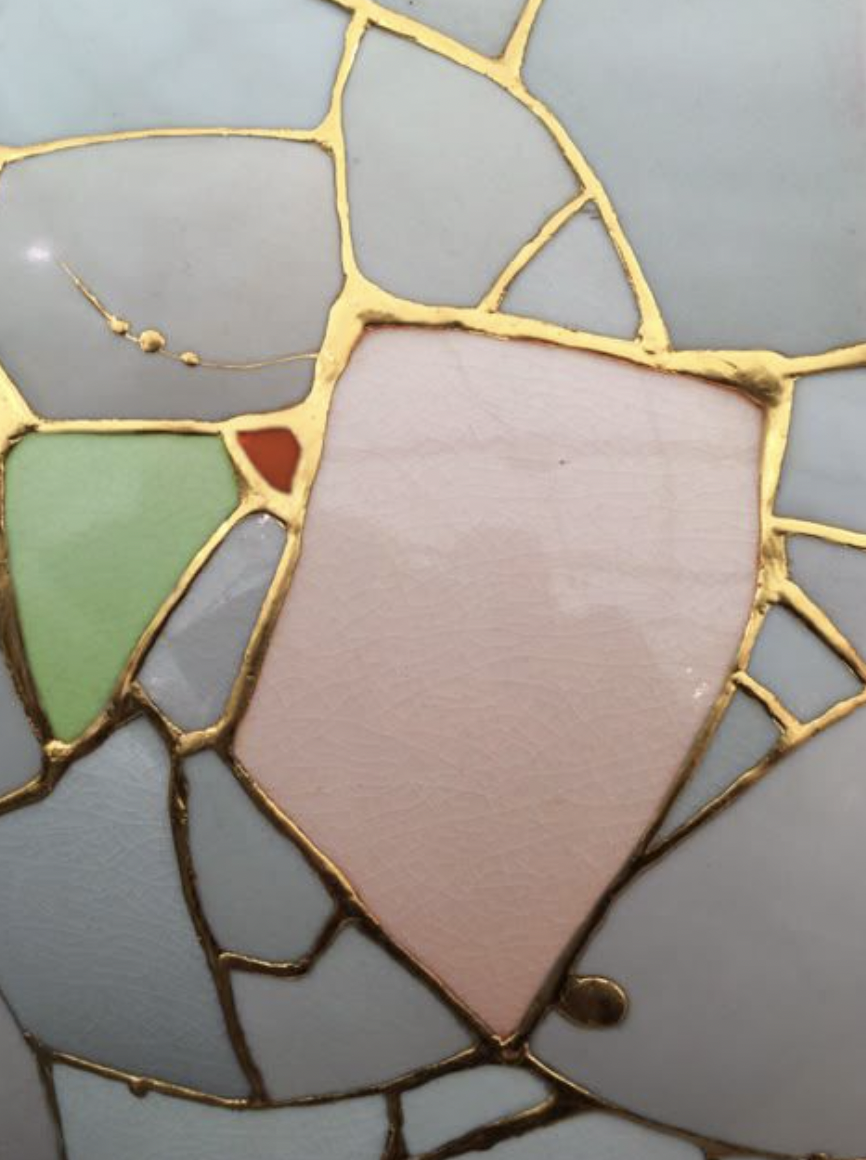
What they arrived at was kintsugi: "golden joinery." Broken ceramics are pieced back together with urushi, a lacquer made from tree sap, and the seams are dusted or mixed with powdered gold. The fracture isn't hidden but instead highlighted, made into the most luminous part of the object. A bowl that has been through kintsugi is, by most accounts, more valued than it was before it broke.
It's an idea that has travelled a long way from the tea ceremony. You'll find it on mugs, in therapy rooms, tattooed on wrists. And it would be easy to dismiss as one more piece of Japanese philosophy flattened into a motivational poster. But underneath the gift-shop version is something worth taking seriously, particularly if you've ever been unwell, heartbroken, or flattened by a job, and come out the other side as someone you didn't expect.
It came up with a few friends this week. In fairness, the conversation didn't start anywhere profound. It started, as these things often do, with a collective airing of irritation about the men in our lives. But somewhere around the third anecdote, it turned, and we found ourselves in a proper deep dive. We stopped talking about the men and started talking about ourselves: the break-ups that had flattened us, the jobs that had chewed us up, the stretches of being unwell none of us would choose to repeat. What struck me was how many of us pointed to one of those moments as the point where things actually started to get better. Which is, more or less, the whole point of the bowl.
The myth of the unbroken
Wellness, as an industry, has a complicated relationship with brokenness. Much of it is sold as prevention: optimise now so that nothing ever goes wrong. Track the sleep, stack the supplements, protect the glucose curve. There's value in that, and I'd be a strange sort of nutritional therapist if I said otherwise. But it carries an unspoken promise that the goal is to stay intact. That a life done properly is a life without cracks.
Anyone who has sat in a clinic, on either side of the desk, knows that isn't how it works. Most people don't arrive at wellness from a place of curiosity. They arrive because something ‘broke’. The gut that stopped cooperating, the fatigue that wouldn't lift, the panic attack in the supermarket or the hormonal acne that just wouldn’t budge.
And here is the thing I've noticed, again and again, in clients and in friends and in myself: the version of a person who comes back from being unwell is rarely the same as the version who went in. They're often more interesting. More honest about what they need. Less willing to tolerate the things that were hurting them. The breaking wasn't the good part. But what grew in the seam often is.
What the research calls growth
Psychologists have a name for this. In the mid-1990s, Richard Tedeschi and Lawrence Calhoun at the University of North Carolina began studying what they called post-traumatic growth: the positive psychological change some people report after a period of serious struggle. Not resilience, which is about bouncing back to where you were, but something closer to bouncing forward.
Their research identified the areas where growth tends to show up: a deeper appreciation of life, closer and more honest relationships, a sense of personal strength, a shift in priorities, and an openness to new possibilities. People who had been through illness, bereavement and loss described, alongside the pain, a clearer sense of what mattered.
It's worth being careful here, because there's a version of this idea that becomes its own kind of pressure. Growth is not guaranteed, and it isn't a debt you owe your suffering. Plenty of people go through terrible things and simply survive them, which I personally believe, is achievement enough. The researchers themselves are clear that growth sits alongside distress rather than replacing it. You can be changed for the better by something and still wish, with your whole heart, that it hadn't happened.
That, I think, is where kintsugi is more honest than most self-help. The gold doesn't pretend the bowl never broke. It makes the break impossible to ignore.
The unwell years
If you've lived through a long stretch of illness, you'll know the particular grief of it. Not only the symptoms, but the loss of the person you thought you were: the one who could say yes to everything, who never needed to read a label or leave early or explain herself.
Recovery, when it comes, is rarely a straight line back to that person. More often it's a slow, sometimes reluctant renegotiation. You learn what your body actually tolerates rather than what you'd like it to. You learn to ask for help. You find out which friends turn up with soup and which ones go missing. You develop, almost against your will, a kind of literacy about yourself that the healthy version of you never needed.
This is what I mean when I say the transition is so often the best part. Not the illness, but the middle bit, the mending. It's where people make the decisions that change the rest of their lives: they leave the job, end the relationship, retrain, move cities, start sleeping properly, address their drinking, finally take their own needs as seriously as everyone else's. Very few people make those changes from a place of comfort. The crack is what lets the light, and the new information, in.
A broken heart is not a metaphor
We talk about heartbreak as if it's poetic. The body doesn't seem to agree.
In a 2011 study published in the Proceedings of the National Academy of Sciences, researchers led by Ethan Kross at the University of Michigan scanned the brains of people who had recently been through an unwanted break-up while they looked at photos of their former partners. The regions that lit up overlapped meaningfully with those involved in processing physical pain. Social rejection, it turns out, isn't entirely separate from the experience of being hurt.
At the far end of the spectrum sits takotsubo cardiomyopathy, sometimes called "broken heart syndrome," in which intense emotional stress (grief, shock, the end of something) triggers a temporary weakening of the heart muscle. It mostly affects women, and most people recover fully. But its existence says something: the heart, in a very literal sense, registers loss.
So when you're lying on the bathroom floor convinced you're overreacting, you're probably not. Your nervous system is treating this as a genuine injury, because in many ways it is one.
And yet. Ask most people about the relationship that broke them, a few years on, and you'll often hear some version of the same thing: it was the worst thing that happened to me, and I wouldn't be who I am without it. The heartbreak that taught them what they'd been accepting. The months or even years alone turned out to be the first time they'd ever really liked their own company. The new standards, set in gold, for what they'll let in next.
Mending, slowly
The part of kintsugi that rarely makes it onto the mugs is how slow it is. Urushi lacquer has to cure in humid conditions, layer by layer, and a single repair can take weeks or even months. Rushing it ruins the piece. You can't skip to the gold.
That feels important. So much of modern recovery culture is impatient: the seven-day reset, the post-break-up glow-up, the "new job, new me" announcement before the old wound has even closed. Real repair asks for something less photogenic. Doing rest, nourishment, boring consistency - but doing it WELL. People who'll sit with you while it sets. Time in which nothing much seems to be happening, which is precisely when the binding is taking hold.
If you're in the middle of something now, unwell, heartbroken, reeling from a job that went wrong, you don't need to find the meaning yet. You don't need to be grateful for it, or turn it into a lesson, or post about it. You just need to let it cure.
The gold comes later.
Words by Eleanor Hoath for The Well Edit.
The content published by The Well Edit is for informational and educational purposes only. It is not intended as, and should not be relied upon as, a substitute for professional medical, health, nutritional, legal, or financial advice. While articles may reference insights from qualified practitioners or experts, the views expressed are their own and do not necessarily reflect the views of The Well Edit. Always seek the guidance of a qualified professional before making changes to your diet, lifestyle, supplementation, or healthcare routine.
Use of any information provided is at your own discretion and risk.