
After the Clocks Go Back: Why You Feel Jet-Lagged Without Leaving Home

Every year, it arrives on schedule. The clocks go back, the “extra hour” is spent mostly asleep, and for a day or two the mornings feel almost generous. Then comes the first Tuesday you leave work at half five into total darkness, and something shifts. You’re hungrier, slower, less yourself. By November, getting out of bed feels like an act of negotiation.
We tend to file this under winter, as though it were weather: something that happens to us, to be waited out with soup and box sets. But the more you understand about how the body clock actually works, the clearer it becomes that what most of us are experiencing could be a deficiency. And like any deficiency, it has a cause, a mechanism and, mercifully, a fix.
The hour is a red herring
Each October, the conversation fixates on the lost or gained hour. It’s the least interesting part of the story.
“The extra hour itself actually has some benefits,” says Anya Ratnavel, Chief Operating Officer at Sunday Light, who holds a first in Experimental Psychology from Oxford. “The mornings will be lighter for a short time, which makes it easier to get the bright light you need when you wake up. The problem is the darkness that follows, as the days keep shortening until late December.”
In the UK, the daily light we’re exposed to falls by almost two thirds between summer and winter. That matters because of a quirk most of us were never taught: our internal body clocks don’t run on a neat 24 hours. They run slightly long, and they rely on a strong dose of morning light to pull them back into line each day.
“Without that signal, the clock naturally drifts a little later each day,” Anya explains. “It can feel like a mild form of jet lag, and it shows up as poorer sleep, low energy and low mood, particularly through the winter. In more extreme cases, it can lead to Seasonal Affective Disorder.”
Which reframes the whole season. The winter slump isn’t just a mood. For many of us, it’s months of low-grade jet lag without ever leaving the country.
The great indoor mismatch
If the dark were only outside, we’d cope. The deeper problem is where we spend our days.
“A typical living room is around 100 to 300 lux, and a well-lit office about 500,” Anya says. “Outside on a cloudy day you’d get around 5,000 lux, and on a sunny day around 100,000. So even on a grey winter’s day, stepping outside can be ten to fifty times brighter than a typical home or office.”
Read that again, because it upends one of our most basic assumptions. The bright, airy kitchen you think of as well-lit is, to your biology, closer to dusk. We are a species that evolved under the open sky, now living almost entirely in rooms, and in winter that gap becomes a chasm.
We don’t feel it because our eyes are remarkably forgiving. Nat Martin, Sunday Light’s founder and CEO, who studied circadian physiology at Oxford before building the company, explains that the eye is doing two jobs at once.
“We have specialised receptors in the eye, separate to the rods and cones we use to see, which read light for our body clock,” he says. “They’re called ipRGCs, intrinsically photosensitive retinal ganglion cells. Their job is to tell your body clock the time of day. So the eye is really a dual sense organ: one part for vision, and one for time.”
“The eye is really a dual sense organ: one part for vision, and one for time.”
Those receptors contain a pigment called melanopsin, which responds most strongly to blue light at around 480 nanometres, the kind that pours from a bright morning sky. Your vision adapts to a dim room within seconds. Your time-sense doesn’t. It simply registers that day never properly arrived.
We’ve lit our lives backwards
Here’s the irony. Even as we under-light our days, we over-light our nights.
“Most homes get light the wrong way round,” Anya says. “Too dim in the morning, and too bright late at night.” We wake to a single bedside lamp, sit in a dim kitchen, commute in the dark, work under a flat office light, then come home and switch on every overhead bulb, phone in hand, until bedtime.
Nat puts it more poetically. “Warm, dim light is great later in the day. It’s basically mimicking firelight. The problem is we’ve lit our whole day that way.”
Think of it as a diet. If light is the nutrient the body clock runs on, most of us are eating almost nothing at breakfast and bingeing before bed. No wonder the system feels off.
Building a sun for the kitchen ceiling
Nat came to this the way most good founders do: from personal misery. After living in Los Angeles, he moved back to London in the depths of winter. “I felt awful,” he says, “and it was just the lack of sunlight.” He knew from his research exactly what was happening, and he knew SAD lamps existed. “But I didn’t want to sit in front of one every morning. It’s not practical or enjoyable. I wanted the feeling and benefits of a sunny day inside my home.”
The result is the Sunday Light, a ceiling fixture that produces 34,500 lumens, roughly the brightness of film-set lighting. The engineering challenge wasn’t brightness; it was making that brightness bearable. A tiny, intensely bright source shines up at a large panel that scatters light the way the atmosphere does, using the same physics, Rayleigh scattering, that turns the sky blue. The panel glows sky blue with a warmer “sun” at its centre. The LED is water-cooled so it can run at full intensity all day, and its spectrum is close enough to sunlight that colours look as they would outdoors.
“We didn’t set out to design a light fitting,” Nat says. “We set out to design the light itself.”
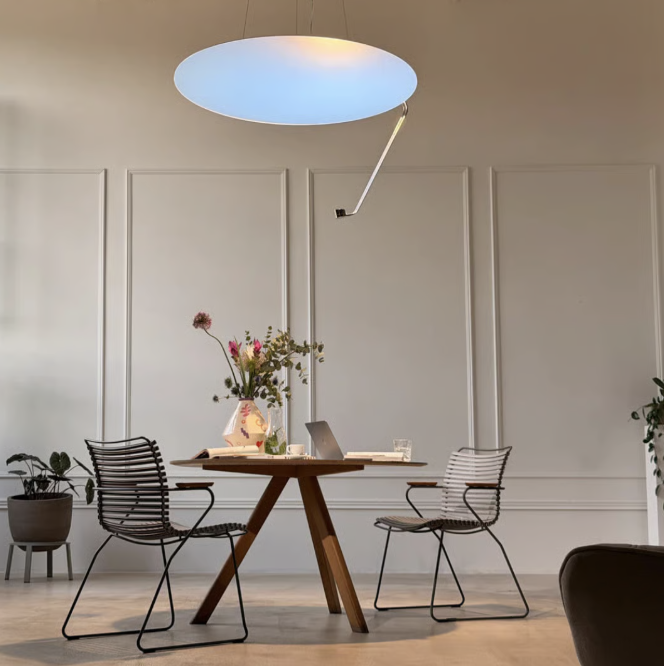
The distinction from a SAD lamp is less about the science than about human nature. Bright light therapy works, Anya is clear, and the evidence for it is extensive.
“It isn’t that comfortable to shine a bright light in your face each morning, so people often aren’t consistent with it.” A light that fills the room removes the effort entirely. As Professor Russell Foster, Director of Circadian Neuroscience at Oxford and an adviser to Sunday Light, puts it: “You do not have to sit next to the device to get the levels of light that will deliver physiological benefits.”
Light you can put on a desk
A ceiling-mounted sun is, for now, an investment. For most people, the accessible version of the same idea is a light therapy lamp, and in the UK the name to know is Lumie, the Cambridge company founded in 1991 that created the first wake-up light the following year.
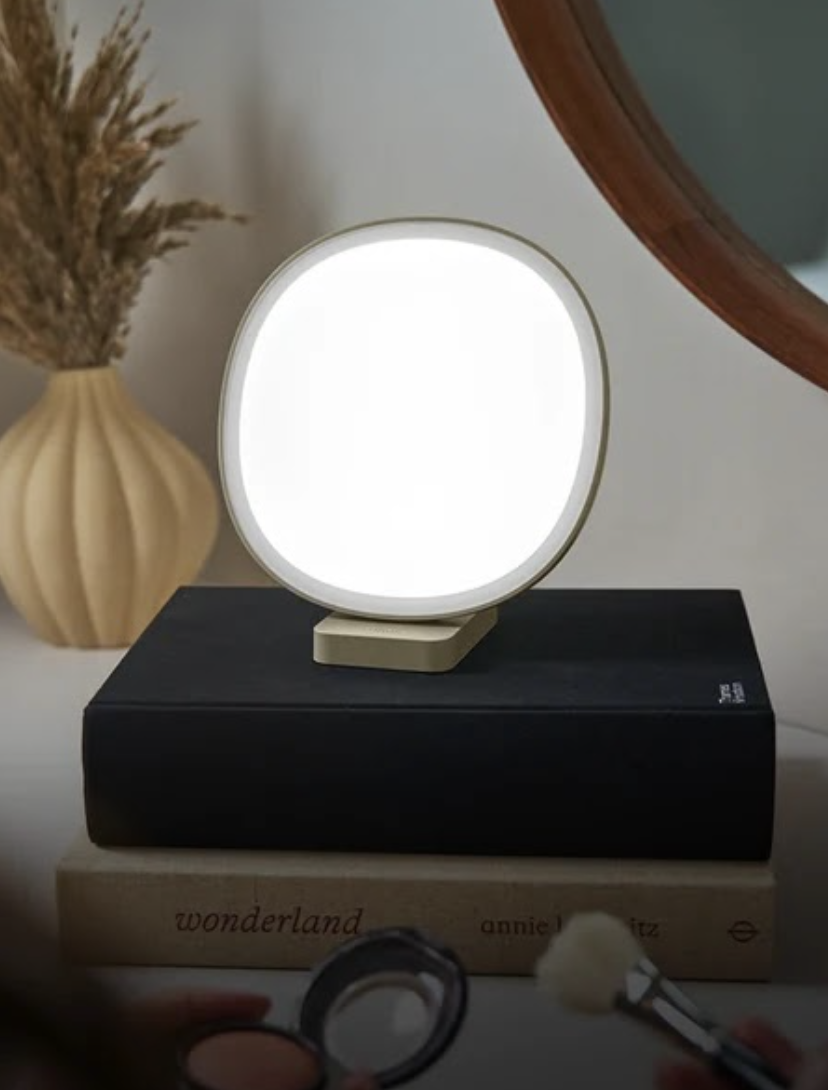
Its SAD lamp, Vitamin L, is a slim Class IIa medical device delivering 10,000 lux at 22cm, typically used for around 30 minutes. It works in portrait or landscape, which means it can live on a desk or breakfast table rather than in a cupboard.
“I really love the Vitamin L lamp because it’s small enough to put in my bag with my laptop too, days when I’m at the office or on my laptop all day, I literally pop it next to the screen”
The newer Lumie Dash is the one for anyone who has resisted light therapy on aesthetic grounds. It delivers 10,000 lux to simulate the brightness of natural light, with adjustable brightness so it doubles as an everyday lamp. A colour rendering index of 95+ keeps text, objects and colours crisp, and it’s small enough to move from desk to bedside. It’s £179.
The most common mistake with any lamp is treating it as optional decor. Lumie recommends starting with 30 minutes a day at arm’s length and full brightness, ideally in the morning. You don’t stare into it. You simply let it reach your eyes while you eat, read or clear your inbox.
Green time before screen time
If you take one habit from this piece, make it the one Eleanor Hoath, founder and editor of The Well Edit and a registered nutritional therapist, repeats all year round, an especially in the autumn: green time before screen time.
“Before you look at your phone, look at the sky,” she says. “Even five or ten minutes outside first thing, a walk to the corner, coffee on the doorstep, gives your body clock the signal it’s been waiting for all night. In summer, we get away with skipping it, because light finds us anyway. From now until spring, it won’t. You have to go and get it.”
“In summer, light finds us anyway. From now until spring, you have to go and get it.”
The order matters more than it seems. The first thing most of us do on waking is flood our attention with a small, dim, demanding screen, often before we’ve opened the curtains. It tells the brain to start working while telling the body clock nothing at all. Reversing it costs no money and very little time.
Anya’s advice for anyone without a light at home is the same. “Get outside in the first hour of waking, even for 20 to 30 minutes. It doesn’t need to be sunny. A cloudy winter morning is still many times brighter than your kitchen.” And if mornings truly won’t allow it, bring daylight into the working day instead: take the call on foot, or drink your coffee outside.
The first three days after the change
Gary Brecka, the wellness figure known for his work on longevity and daily routine, focuses on the immediate aftermath of the change, and his advice comes down to protecting the clock’s three strongest cues.
The first is light. Gary recommends getting outside within 10 to 20 minutes of waking, even when it’s overcast, because morning daylight clears lingering melatonin, sharpens alertness and tells the body the day has begun. Through the rest of the day, small doses still count: a lunchtime walk, a lap of the block, a few minutes outdoors between meetings.
The second is food. Meal timing is one of the body clock’s quieter signals, so Gary suggests keeping a consistent eating window and avoiding late meals or night-time snacking for the first three days after the clocks change, giving the body a steady rhythm to settle into.
The third is the evening. Bright artificial light and screens late at night interfere with melatonin, so he recommends dimming the house, switching to warmer lamps and putting screens away earlier than usual, with a warm shower, a few minutes of slow breathing and a cool, dark bedroom to finish.
His summary is one word: consistency. Hold those cues steady for three days, and the body adjusts with far less friction.
What about blue-blocking glasses?
If the problem at night is light reaching those time-telling receptors, it follows that blocking it should help. That’s the logic behind blue-blocking glasses, and it’s sound, with one important caveat: they only work if you wear them at the right time.
The melanopsin receptors that respond so strongly to blue light in the morning don’t switch off at sunset. Every bright overhead bulb, laptop and late-night scroll sends the same “it’s daytime” message, pushing back the release of melatonin just as your body should be winding down. Amber or red-tinted lenses filter out that part of the spectrum, letting you live in the evening without telling your body clock it’s noon.
The evidence is more nuanced than the marketing.
When to wear them.
Timing is everything. Put them on once it’s dark, or around two to three hours before you plan to sleep, and keep them on until lights out. Most brands suggest at least one to two hours of continuous wear before bed to make a difference.
Just as important is when not to wear them. In the morning, blue light is exactly what you want, so leave the glasses on the bedside table until evening. Wearing them at breakfast would undo the very signal this entire piece is about getting more of. And amber night lenses aren’t suitable for driving.
“I’ve just been introduced to Swanwick, founded by Australian brothers James and Tristan Swanwick after their own battle with sleepless nights. What caught my eye is how practical they’ve made it: the glasses come in prescription, with multiple lens options, including clip-ons, so if you already wear glasses you don’t have to choose between seeing clearly and protecting your evenings. I spend a lot of time on a screen so from time to time I’ll use the yellow ones and then clip onto the red in the evenings. I’ll be trying them through the darker months and will report back.”
We’ve been taught to treat the darker months as something to endure, a season of lower expectations and comfort eating that we push through until spring. But much of what we call the winter slump is the predictable result of starving the body of its most fundamental time signal, then confusing it further after dark.
Words by The Well Edit.
The content published by The Well Edit is for informational and educational purposes only. It is not intended as, and should not be relied upon as, a substitute for professional medical, health, nutritional, legal, or financial advice. While articles may reference insights from qualified practitioners or experts, the views expressed are their own and do not necessarily reflect the views of The Well Edit. Always seek the guidance of a qualified professional before making changes to your diet, lifestyle, supplementation, or healthcare routine.
Use of any information provided is at your own discretion and risk.