Men Have Hormones Too; The Ad That Struck a Nerve

If you’ve spent any time on social media this week, you’ll likely have seen the Voy adverts plastered across the London Underground and circulating online:
“Men get hormonal too.”
“It’s not him, it’s his hormones.”
The backlash was swift, emotional, and, importantly, deeply telling. At face value, these ads are about men’s health. Testosterone. Mood. Energy. Libido. Things we absolutely should be talking about more openly. Yet the reaction from many women wasn’t confusion - it was frustration, anger, and exhaustion. And that response didn’t come out of nowhere.
To understand why these adverts sparked such an intense reaction, we have taken the authentic and truthful approach and zoomed out. Because it's not just about testosterone. It’s about history, whose bodies have been studied, whose symptoms have been dismissed, and whose suffering has been normalised.
When women were left out of science (and still often are)
For centuries, women’s bodies were considered too complex to study. Hormonal cycles were inconvenient. Pregnancy was labelled a “confounding variable”. As a result, men became the default research subject in almost everything, not because their biology was more important, but because it was easier.
The consequence? Drug safety, efficacy, and dosing were often studied almost exclusively in male bodies and then generalised to women, despite clear biological differences in hormones, metabolism, and physiology.
The long-standing assumption that women are simply “small men” has left a lasting imprint on healthcare. (#womenarenotsmallmen)
This gap was only formally acknowledged when policies began to shift in the 1990s. The NIH Revitalisation Act of 1993 mandated the inclusion of women in NIH-funded clinical research - a landmark step forward. Yet, despite this, gender imbalance in study design, analysis, and interpretation has persisted for decades. This isn’t limited to medicine. The same systemic bias also appears in areas such as safety engineering. Male crash-test dummies have historically been the default, despite repeated petitions highlighting that women are at greater risk of injury in car accidents due to differences in anatomy and biomechanics.
The RESULT OF THE DIVIDE - modern medicine has been built on a male physiological template.
Heart attack symptoms were defined by how they present in men (and yes, they often present differently in women). Drug dosages were calibrated to male metabolism, which helps explain why women experience adverse drug reactions more frequently and, in some cases, derive less benefit. Pain thresholds, stress responses, and even “normal” lab ranges have been shaped by male data. Meanwhile, women reporting symptoms have routinely been told they are emotional, psychosomatic, or that what they’re experiencing is “just part of being a woman”
So when women see a bold, sympathetic public campaign about male hormones, while their own hormonal experiences (PMS, PMDD, endometriosis, perimenopause… the list goes on?) remain underfunded, underdiagnosed, and routinely trivialised, it doesn’t land well, it feels like history repeating itself, and it can sting.
research still centres on male biology
Yet this imbalance isn’t just historical, it’s ongoing. Despite improvements, many large-scale datasets and training models (including those used in emerging technologies, AI-driven health tools and engineering) remain disproportionately male-centric. Clinical trials continue to under-represent women, particularly those of reproductive age.
That becomes a problem not because women like to have a moan, but because it seriously means women often receive:
Later and prolonged diagnoses
Less precise treatment options
Fewer evidence-based answers
So when an advert appears to reframe men as “hormonal” - a label long used to undermine women - it understandably touches a raw nerve. Not because men don’t have hormones (they do and they matter), but because women have always had hormones and have paid the price for how that fact has been weaponised against them.
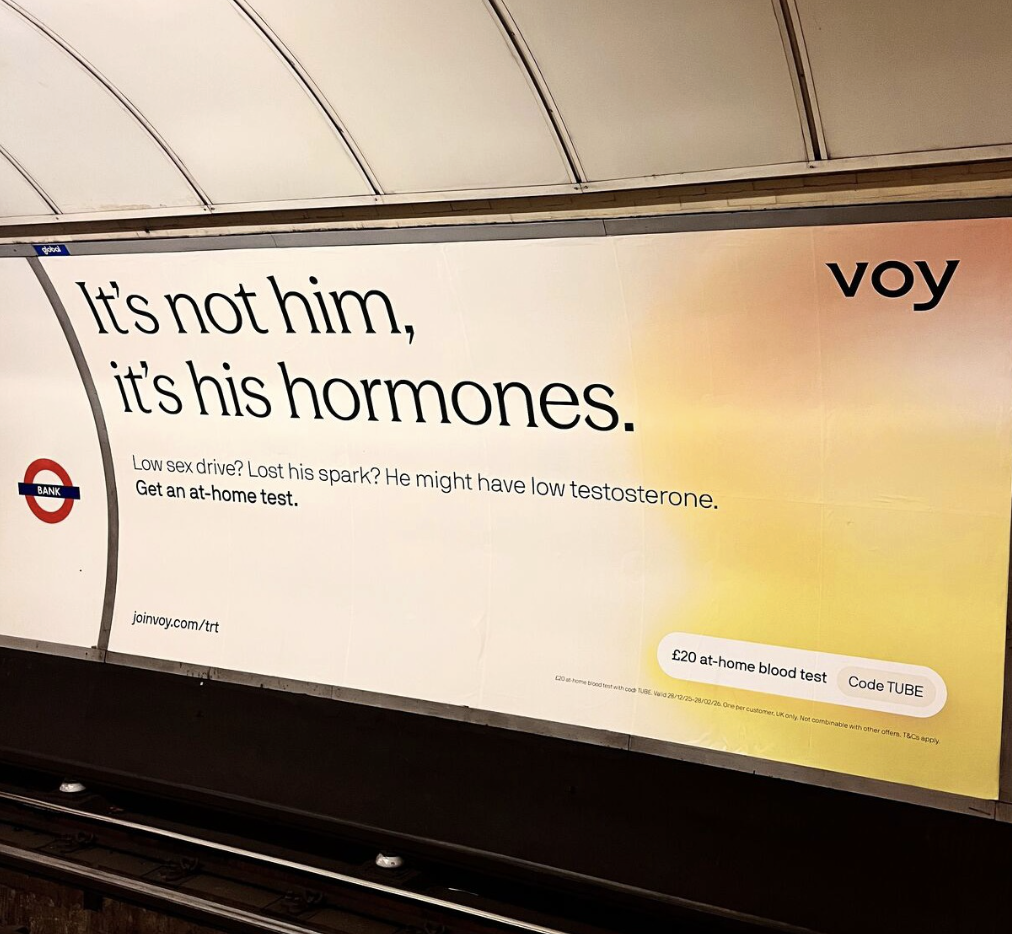

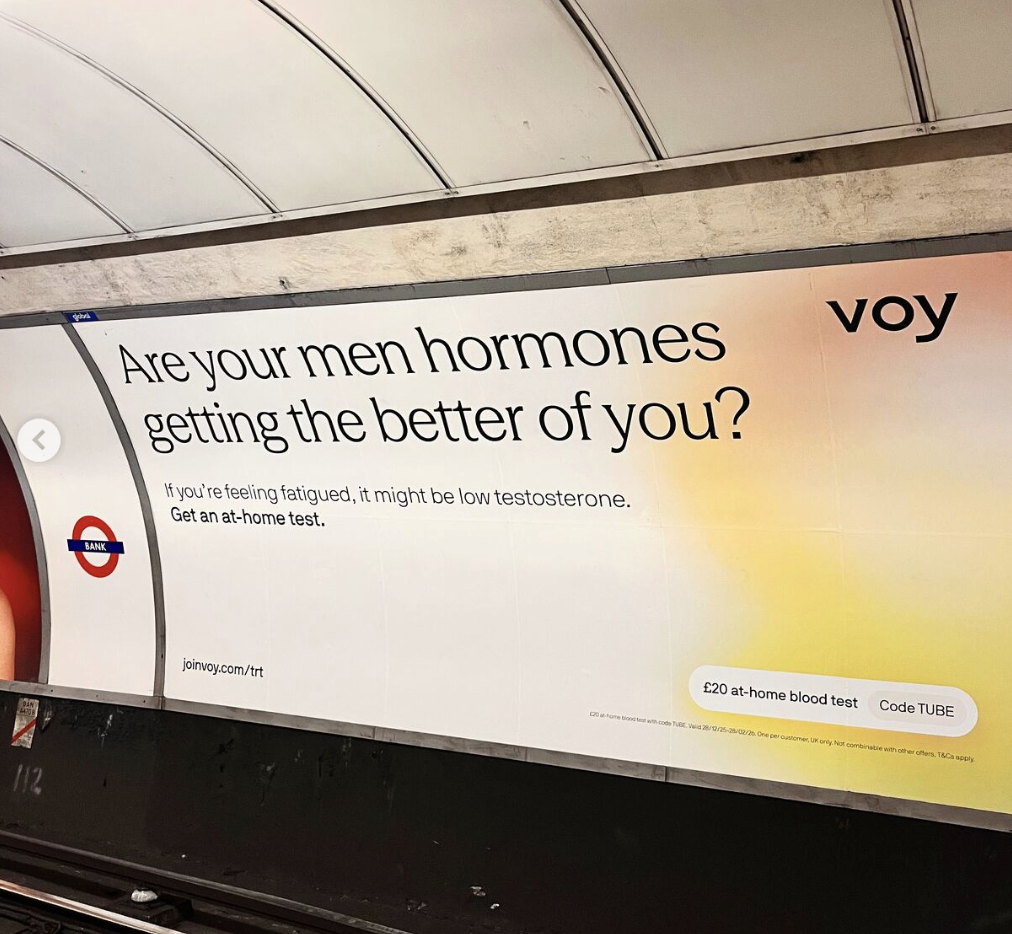
Why has the voy advert caused such uproar
The issue isn’t that men experience hormonal changes. The issue is language and context. For generations, “she’s hormonal” has been shorthand for: She’s irrational. She’s overreacting. She can’t be trusted.
In contrast, when similar language is applied to men, it is often used to explain or even excuse behaviour, rather than dismiss it. So when people read: “It’s not him, it’s his hormones”, it hasn’t exactly landed as compassionate healthcare messaging - it hit as asymmetrical empathy. That doesn’t mean men’s hormonal health shouldn’t be discussed. It means that how we talk about hormones matters, because language reflects whose pain we take seriously.
But hang on… what does low testosterone look like in men?
Here is where nuance and balance matter. Low testosterone (sometimes called hypogonadism) is real, and for some men it significantly impacts their quality of life. Symptoms can include:
Persistent fatigue
Low mood or depression
Reduced libido
Loss of muscle mass and bone density
Increased body fat
Poor concentration
Reduced motivation
Testosterone levels also naturally decline with age, but lifestyle factors play a huge role. Chronic stress, poor sleep, ultra-processed diets, excess alcohol, metabolic dysfunction, and lack of resistance training can all suppress testosterone production. Importantly, low testosterone doesn’t make someone aggressive or abusive. Hormones can influence mood and energy, but they do not remove accountability. Just as women’s hormones don’t excuse harmful behaviour, neither do men’s.
Understanding male hormones should be about support, not absolution. Men are still far less likely to talk openly about their health, symptoms, or hormones, and shutting down those conversations doesn’t create space for women to be heard; it just means no one is, and the conversation stops entirely.
Hormones aren’t equal, but they are universal
It seems relevant to delve into how we are living with the same hormones (oestrogen, testosterone, progesterone, etc.), but men and women experience these hormones on entirely different timelines.
Men’s hormonal rhythms operate on a 24-hour cycle - more or less. Testosterone typically peaks in the morning and gradually declines throughout the day, closely linked to sleep, stress, and daily habits. Energy, focus, and libido often follow this predictable daily rise and fall. Women’s hormones, by contrast, move through a 28-day cycle (all being well), with oestrogen, progesterone, and follicle-stimulating hormones rising and falling across distinct phases. These shifts influence energy, appetite, cognition, emotional resilience, training capacity, and stress tolerance - not day-to-day, but week-to-week on more of a rollercoaster pattern than an eb and flow.
This difference matters.
When we treat all humans as though they operate on a daily hormonal rhythm, women are inevitably misunderstood. Expecting consistent productivity, mood, energy, and performance every single day makes sense for a body governed by a circadian cycle, but it ignores the biological reality of a monthly one.
What’s encouraging is that this is beginning to change.
There is a growing movement - particularly among younger generations - towards understanding the female cycle rather than suppressing or ignoring it. Concepts like cycle syncing, flexible training, and adapting workload, nutrition, and recovery across the menstrual cycle are becoming more mainstream.
We’re finally talking about it more openly.
And, this shift isn’t just happening among women. More couples are learning about the menstrual cycle together. Women are teaching their partners how their energy, needs, and capacity change across the month (I taught mine). Men are learning when support matters most, when communication might feel harder, and when connection can feel easier. This isn’t about making women “manageable”; it’s about biological literacy, and when both partners understand each other’s hormonal rhythms and the symptoms or feelings that come with it, empathy increases rather than resentment.
Understanding men’s daily hormonal patterns and women’s monthly ones doesn’t divide us. It gives us shared language. And shared language is how health conversations become collaborative, not competitive.
*Editors note - with segments like Rosie & Harry’s “Hormones with Harry” we’re seeing more and more couples talking openly about womens cycles. Whilst menstrual tracking apps such Flo introduced the partner tracker so he can see where she is in her cycle too.
How do we move forward so we aren’t pitting men and women against each other?
This is the most important part because we don’t fix women’s health by silencing men. And we don’t support men’s health by minimising women’s experiences.
The real opportunity here is integration, not competition. We don’t rebalance by swinging the pendulum in the opposite direction. When men begin to understand hormonal health, they often gain greater empathy for what women experience monthly, across pregnancy, and through menopause. When women’s hormonal health is properly researched and respected, it creates a framework that benefits everyone.
What’s actually needed is:
Appropriately and better-funded research into both male and female hormones
Language that validates experience without excusing behaviour
Health messaging that educates rather than inflames
A move away from “either/or” narratives
Communication across the sexes and lead by listening
Hormones aren’t a weakness; they’re a biological reality for all of us. So, perhaps the most radical thing we can do is refuse to let a flawed healthcare system turn us against each other. After all, if we have men and women we love in our lives, surely we want to know what life is like for them, too. .
Final thought
Women are understandably frustrated by these adverts. Men are allowed to want hormone support.
Those two truths can - and must - exist at the same time. If this debate pushes us toward more inclusive research, more thoughtful language, and a deeper understanding of hormonal health across the lifespan, then something meaningful can come from the outrage. Not by shouting over each other, but by finally being heard together.
Words by Natalie Louise Burrows
The content published by The Well Edit is for informational and educational purposes only. It is not intended as, and should not be relied upon as, a substitute for professional medical, health, nutritional, legal, or financial advice. While articles may reference insights from qualified practitioners or experts, the views expressed are their own and do not necessarily reflect the views of The Well Edit. Always seek the guidance of a qualified professional before making changes to your diet, lifestyle, supplementation, or healthcare routine.
Use of any information provided is at your own discretion and risk.