The Frigid Truth: Why Your Cold Plunge Needs to Sync With Your Cycle
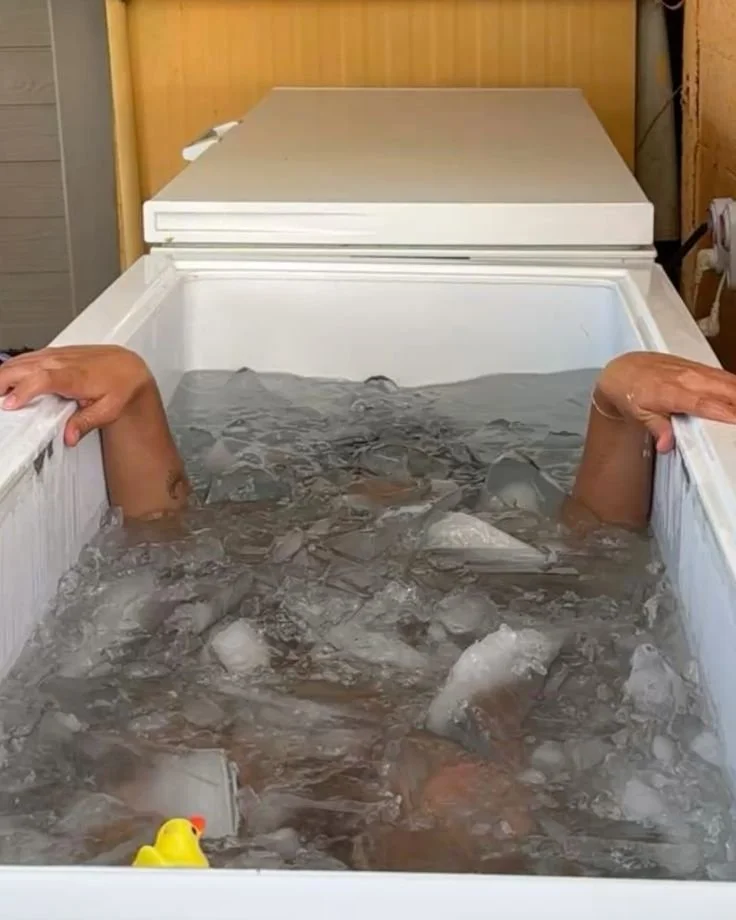
We have all seen the aesthetic: the minimalist steel tub, the steam rising off the surface, and the serene face of someone submerged in 4°C water. Cold plunging has transitioned from a niche biohack to a mainstream wellness ritual, promised as the ultimate cure for everything from sluggish metabolism to low mood.
For men, who operate on a steady 24-hour testosterone cycle, a daily ice bath is a predictable stressor with predictable rewards. But for women, we are not "small men." Our physiology is a dynamic, four-phase seasonal shift, and what serves us in our follicular spring can actively sabotage us in our luteal autumn. If you are shivering in an ice bath during your pre-period week because a podcast told you to "embrace the cold," you might be doing more than just testing your mental toughness; you might be tanking your progesterone.
The Neuroendocrine Mismatch: Why Colder Is Not Always Better
The prevailing "colder is better" narrative is rooted in research that largely excludes women. Recent insights from exercise physiologists like Dr Stacy Sims highlight a critical distinction: women generally vasoconstrict faster and experience greater drops in core temperature than men [1]. This sensitivity is not a weakness; it is a feature of our complex thermoregulatory system, which is heavily influenced by oestrogen and progesterone.
When we subject our bodies to extreme cold (below 10°C), we trigger a massive sympathetic surge, a "fight or flight" response. While a brief spike in cortisol and adrenaline can be hormetic (a beneficial stressor), for women, the line between "resilience-building" and "hormone-disrupting" is remarkably thin.
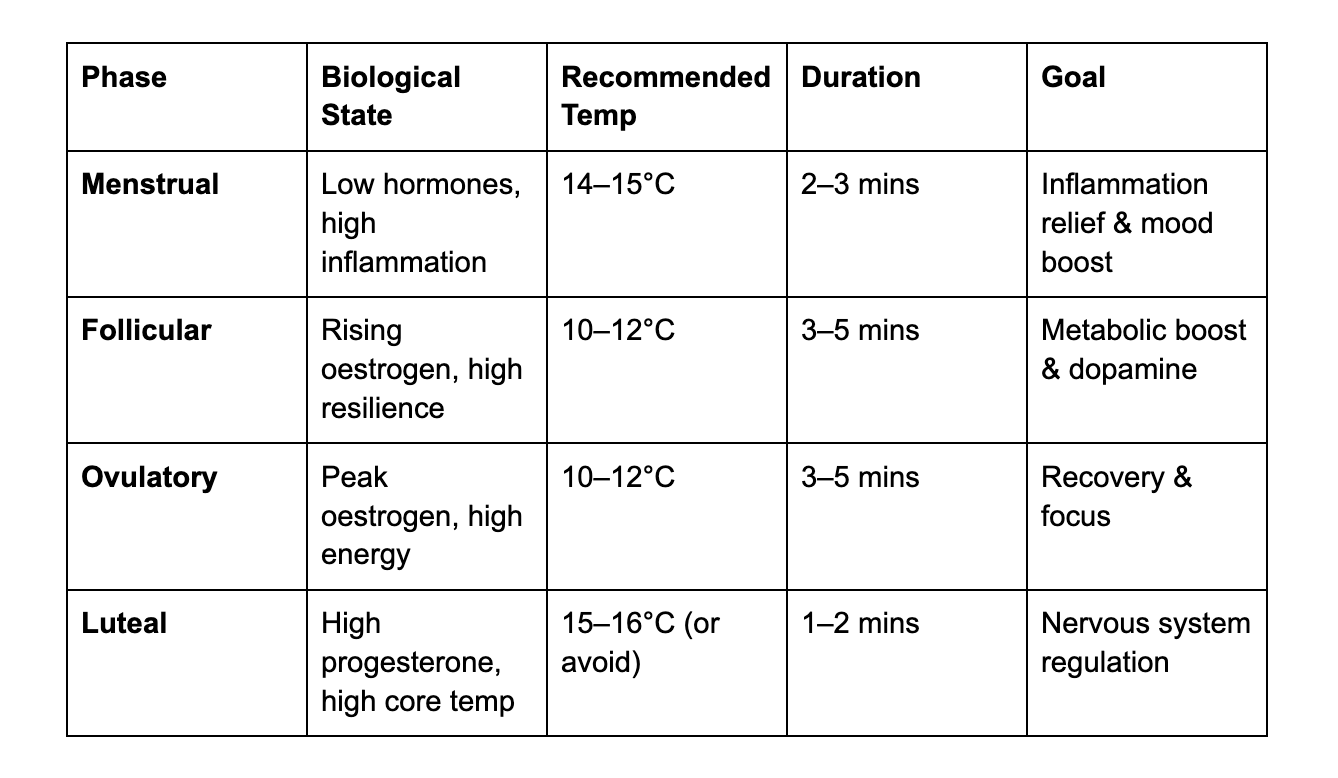
To navigate this thin line, we must move away from the “one-size-fits-all” approach and instead adopt a protocol that respects our shifting biological seasons. By adjusting the temperature and duration of our cold exposure to match our hormonal state, we can harness the benefits of cold water immersion without triggering a chronic stress response. The following framework provides a science-backed guide for syncing your cold plunge with each phase of your cycle, ensuring that your recovery, rituals support, rather than sabotage, your endocrine health.
The Luteal Phase: When Cortisol "Steals" Your Peace
The most precarious time for a cold plunge is the luteal phase, the roughly 10 to 14 days between ovulation and your period. During this time, your basal body temperature naturally rises by about 0.5°C, driven by progesterone. This makes you more sensitive to cold and less efficient at recovering from stress.
There is a biochemical reality often referred to as the "Pregnenolone Steal" or "Cortisol Steal." Both cortisol (our stress hormone) and progesterone (our "keep-calm-and-carry-on" hormone) share a common precursor: pregnenolone [2]. When we introduce a high-intensity stressor like a 4°C plunge, the body prioritises survival over reproduction. It funnels that precursor into making cortisol to handle the cold shock, effectively "stealing" from your progesterone production.
For women already struggling with PMS, anxiety, or a short luteal phase (a classic sign of low progesterone), this cortisol spike can be the tipping point. If you do not see a significant rise in your basal body temperature during your luteal phase, or if your period arrives less than 12 days after ovulation, your body is already signalling that progesterone is low. Adding the stress of extreme cold is like pouring water into a leaky bucket.
The Red Flags: When to Stay Dry
Wellness is not a one-size-fits-all prescription, and for some, the cold plunge should be off the table entirely. Science-backed contraindications include:
Dysregulated Cortisol or Adrenal Fatigue: If you are "wired but tired," suffer from chronic exhaustion, or have been diagnosed with HPA-axis dysfunction, the cold shock response can further deplete your already taxed adrenal glands.
Heart Conditions: The "cold shock response" causes an immediate spike in heart rate and blood pressure. For those with underlying cardiovascular issues, this can be dangerous [3].
Severe PMS or PMDD: If your luteal phase is a minefield of mood swings and physical pain, your nervous system needs safety, not a shock.
Short Luteal Phase: If your cycle is consistently shorter than 24 days, prioritise warmth and progesterone support over cold exposure.
A New Protocol: Smarter, Not Colder
If you want to reap the benefits of cold water therapy, such as improved insulin sensitivity, mitochondrial biogenesis, and that legendary dopamine hit, without sacrificing your hormonal health, we need to shift the goalposts.
For most women, the "sweet spot" for health and longevity is actually around 14–15°C [1]. This is cold enough to trigger the release of norepinephrine and activate brown fat, but moderate enough to maintain parasympathetic balance.
In your follicular phase, when oestrogen is rising and you feel most resilient, you can push the boundaries. This is your "summer," where your body can handle the 10°C dip and the longer duration. But as you transition into your luteal phase, listen to the seasonal shift. Switch to a "cool" plunge rather than an "ice" bath, shorten your time to 60 seconds, or skip it altogether in favour of a warm Epsom salt bath.
The ultimate biohack is not the ability to endure the coldest temperature; it is the wisdom to listen to your own biological clock. We are not linear; we are cyclical. And our wellness rituals should reflect that beautiful, complex reality.
Words by Eva Fleischman for The Well Edit.
References
[1] Sims, S. (2025). Cold Plunging for Women: Why Colder Is Not Always Better. Dr Stacy Sims Research.
[2] Anderson, D. C. (2008). Assessment and nutraceutical management of stress-induced adrenal dysfunction. Integrative Medicine.
[3] Harvard Health Publishing. (2025). Cold plunges: Healthy or harmful for your heart? Harvard Medical School.
The content published by The Well Edit is for informational and educational purposes only. It is not intended as, and should not be relied upon as, a substitute for professional medical, health, nutritional, legal, or financial advice. While articles may reference insights from qualified practitioners or experts, the views expressed are their own and do not necessarily reflect the views of The Well Edit. Always seek the guidance of a qualified professional before making changes to your diet, lifestyle, supplementation, or healthcare routine.
Use of any information provided is at your own discretion and risk.